


Myrmecia pyriformis Care Guide: Keeping the Inch Bull Ant
Myrmecia pyriformis, the inch ant or bull ant from eastern Australia, is one of the most impressive ants you can keep. The workers are huge, they watch you with big eyes and they hunt alone, mostly at dusk and at night. It is also a species with a serious sting, a slow start and a founding queen that needs to hunt. This care guide explains how to keep a Myrmecia pyriformis colony safely and what to look for at every stage.
Want to know more about the species itself first? Read our Myrmecia pyriformis facts post.
Myrmecia pyriformis at a glance
Origin: eastern and southeastern Australia
Colony type: one queen; workers can lay eggs when the queen is gone
Founding: semi-claustral, the queen hunts to feed her first brood
Growth: slow
Temperature: warm room temperature with a slightly warmer spot
Winter rest: recommended, mild and cooler
Humidity: moderate, one part moist and one part drier
Diet: insects for the brood, sugar for the workers
Difficulty: advanced, only for experienced keepers
Appearance and size

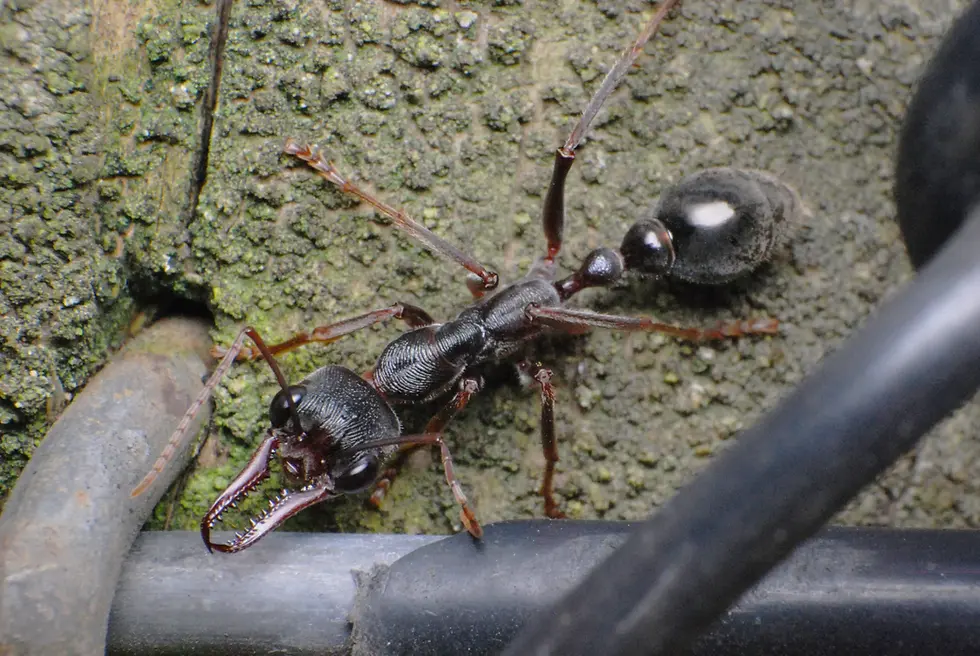
Myrmecia pyriformis workers are long and slender, roughly 15 to 25 mm, which is where the name inch ant comes from. The body is mostly black, with reddish-brown legs and long mandibles lined with teeth. The eyes are large and give the ants very good vision: they turn their heads to follow your hand outside the nest. Workers within one colony vary somewhat in size. The queen looks a lot like a large worker but has a broader thorax, and she is easy to spot in a small colony.
Colony structure
A colony normally has a single queen. One thing that sets this species apart: when the queen dies, workers can mate and lay fertilised eggs, so a queenless colony can carry on for quite some time. For a keeper this changes little, but it explains why wild colonies can survive the loss of their queen. Mature colonies stay fairly small by ant standards, usually a few hundred workers. Read more about this in bull ant colony life.
Founding a colony
Founding is semi-claustral. After the nuptial flight the queen digs a chamber, but she still leaves it to hunt for food for her first larvae. In captivity this means you need to feed the founding queen. Give her access to a small foraging area and offer a small insect now and then. Keep everything dark and quiet: a stressed queen may eat her own eggs or larvae. Check on her only occasionally and do not move the setup around.
Growth
Bull ants grow slowly. The first workers take a long time to appear, and after that the colony grows at a steady but modest pace. How fast it goes depends on warmth, food and the colony itself. You will notice that we rarely give exact numbers in this guide. Every colony develops differently, so we explain what to look for instead: a queen with a steady supply of eggs, and larvae that keep growing, is a good sign.
Temperature and heating
Warm room temperature suits Myrmecia pyriformis well, and a slightly warmer area helps the brood develop. A small drop at night is natural. Always heat from above: lay a heat cable or a heat mat on top of part of the nest, never underneath it, because heat from below causes condensation. Keep in mind that the setting on a heat mat is not the temperature inside the nest. Leave a cooler part so the colony can choose, and watch where the workers keep the brood.
Winter rest
In most of its range the winters are mild but noticeably cooler, and colonies slow down. A winter rest is recommended: give a few months at a cooler temperature without extra heating and offer less food. Keep the nest from drying out during this time. In spring, raise the temperature step by step and the colony will become active again.
Humidity and water
Keep part of the nest relatively moist and another part drier. Hydrate now and then, but not too much. Water drops, condensation or mould mean it is too wet; workers and brood crowding on the moist side mean it is time to add water. Always offer drinking water in the outworld, for example a test tube with a cotton plug or a small water dish.
Feeding
Insects are the main food for the larvae. Bull ant larvae are fed pieces of prey directly, so offer live or freshly killed insects such as crickets, cockroaches or flies. Workers are skilled hunters and readily take live prey. The adult ants drink sugar water, honey water or vanilla flavoured sugar water. Adjust the amount to the size of your colony and remove leftovers before they mould.
Housing
Start a founding queen in a test tube with access to a small foraging area, such as the All-In-One Test Tube Outworld Small. Once the first workers are there, move the colony to a small nest with chambers big enough for these large ants, for example a small Type A Ytong nest or a Medium Mesh Nest, connected to an outworld. Larger colonies can move into a medium or large Ytong nest or a Large Mesh Nest with a spacious outworld such as the Deluxe Medium Outworld. Match the nest to the colony size: too much space too early causes stress and messy chambers.

Behaviour, stings and escapes
Bull ants are calm when left alone, but they defend their nest and their sting is very painful. In sensitive people it can cause a serious allergic reaction. Never handle them by hand. Use long ant keeping tweezers, keep the outworld closed with a lid and apply Fluon to the walls as an extra barrier. Work calmly, because they see movement well and react to it. Do not keep this species if you or someone in your home is known to react strongly to insect stings. Read more about the bull ant sting.
Do not be surprised if the outworld looks empty during the day. Workers mostly come out at dusk and at night to hunt.
Is Myrmecia pyriformis right for you?
Myrmecia pyriformis is a species for experienced keepers who are comfortable with a stinging ant, a slow start and a founding queen that needs feeding. If that is you, few ants are as rewarding to watch. Esthetic Ants offers Myrmecia pyriformis colonies from time to time, from legal sources, but they are not always in stock. We ship live ants all over Europe. For an honest look at the challenges, read Can you keep bull ants?
New to ant keeping? This is not a beginner species. Start with our Ant Keeping Starter Set and the guide how to start keeping ants first, and come back to bull ants once you have some experience.
Sources
Wikipedia. Myrmecia pyriformis.
Reid, S. F., Narendra, A., Taylor, R. W. and Zeil, J., 2013. Foraging ecology of the night-active bull ant Myrmecia pyriformis. Australian Journal of Zoology.
AntWiki. Myrmecia pyriformis.


Comments