


How Bull Ants See: The Remarkable Eyes of Myrmecia
Updated: 1 day ago
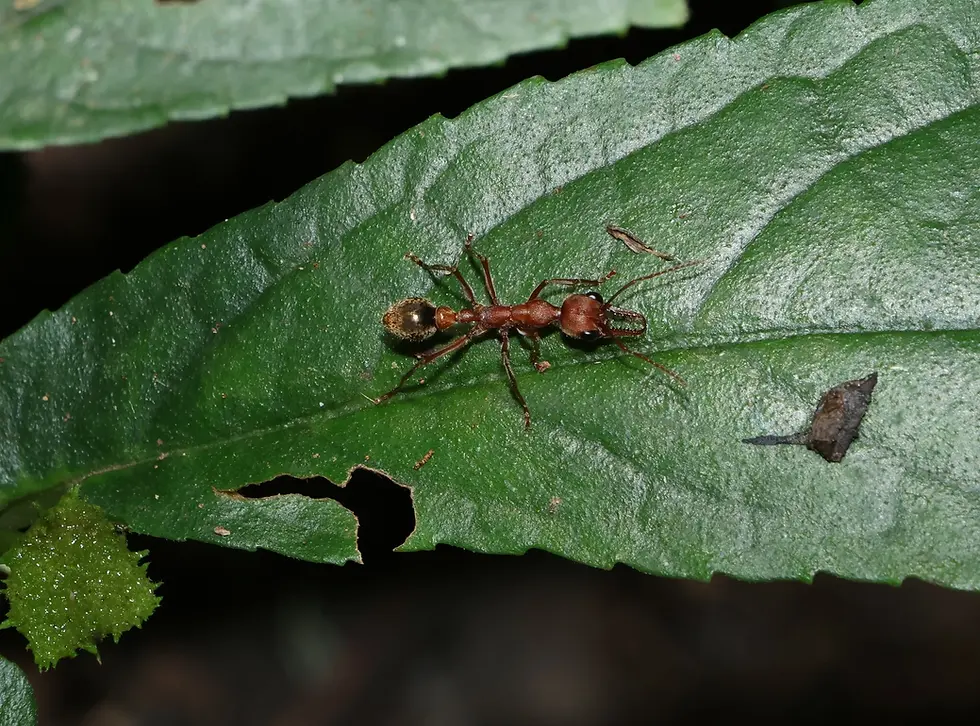
Look a bull ant in the face and the first thing you notice are its eyes. Most ants rely mainly on smell, but bull ants are visual hunters. Their eyes are among the largest in the ant world, and they are tuned to the time of day each species is active. Here is how bull ants see.

Some of the largest eyes in the ant world
A bull ant eye can contain around 3,000 facets, the tiny lenses that together make up a compound eye. That puts bull ants among the ants with the largest eyes of all. Workers spot moving objects from a distance: jack jumpers follow intruders from about a metre away, and Myrmecia gulosa reacts to intruders up to two metres away.
Day eyes and night eyes
Not every bull ant is active at the same time of day. Some species forage in bright daylight, others at dusk or even at night. Their eyes are adapted to that. In 2019, researchers compared the daytime species Myrmecia tarsata with the nocturnal Myrmecia midas. The night species had more facets, around 3,600 compared with 2,600, and its facets were much wider, letting in more light. Read more about this night hunter in Myrmecia midas.

A sharp zone and a bright zone
Both species have a region of extra large facets at the front of the eye. In the daytime species, this region gives the ant extra sharp vision with good contrast, a kind of "acute zone". In the night species, the same region makes the eye more sensitive to light, a "bright zone". Closely related species have evolved different ways of seeing, depending on when they hunt.
The champion of the dark
Myrmecia nigriceps, the black-headed bull ant, starts foraging about an hour before sunset and is most active at twilight. It has the largest eye lenses and photoreceptors of any bull ant, which helps it see in the dark. Read more in Myrmecia nigriceps.
Seeing with polarised light
Bull ant eyes can also detect polarised light, the pattern of light in the sky that is invisible to us. The nocturnal Myrmecia midas uses it to find its way home by moonlight. Read more in how bull ants find their way.
Why good eyes matter
Bull ants hunt alone and do not use scent trails, so they depend on their eyes to find prey, avoid enemies and find their way. They even react to shadows near the nest. Read more in how bull ants hunt, or see our 15 bull ant facts.
Sources
Ogawa, Y. et al., 2019. Spatial resolving power and contrast sensitivity are adapted for ambient light conditions in Australian Myrmecia ants. Frontiers in Ecology and Evolution.
Wikipedia. Myrmecia (ant).
Wikipedia. Myrmecia nigriceps.
Photos: © Prissm


Comments