


How Bull Ants Find Their Way: Learning Walks and Moonlight
Updated: 1 day ago
Most ants find their way by following scent trails laid by their nestmates. Bull ants do not. Each worker forages alone, and still finds its way back to the nest, even in the dark. Researchers in Australia have discovered some remarkable tricks they use.
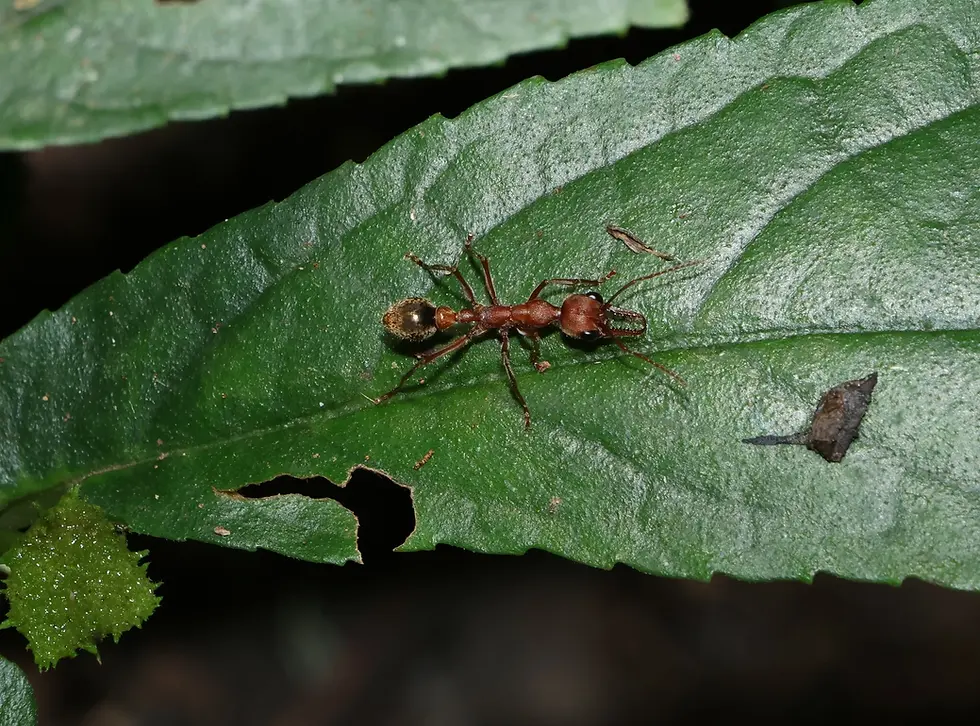
No scent trails
Bull ant workers do not lay pheromone trails and do not call nestmates to food. Every forager relies on its own memory and its own eyes. That makes bull ants an ideal group for studying how insects learn and remember the world around them.
Learning walks
Before a young worker of the jack jumper Myrmecia croslandi goes out to forage for the first time, it makes a few "learning walks" close to the nest. It walks slowly in arcs around the entrance, turning its head back and forth between the direction of the nest and the opposite direction. A 2018 study found that young workers make between two and seven of these walks, spread over up to four days, each time in a different direction. This way, they learn what the area around the nest looks like from many points of view, so they can recognise it later.
Landmarks and the panorama
Once they start foraging, bull ants use the shapes of trees and other features on the horizon as a visual map. Each worker often returns to the same foraging tree day after day.
Navigating by moonlight
The most surprising discovery comes from the nocturnal Myrmecia midas. Researchers showed that it uses the pattern of polarised moonlight in the sky as a compass to find its way home. When they placed a filter above returning ants that rotated this pattern, the ants changed direction to match. According to the researchers, this is the first animal shown to use polarised moonlight to navigate to a fixed place such as its home. The ants could even do it with only a thin crescent moon, when the light signal is much weaker than at full moon.
Twilight foragers
Myrmecia pyriformis forages at dusk and at night too. An earlier study found that its foraging activity was higher during a full moon than during a new moon, which suggests that more moonlight helps these ants see their way.
More about bull ants
Read more about their eyes in how bull ants see, or about the species themselves: Myrmecia croslandi and Myrmecia midas. Curious how they use those eyes to catch prey? Read how bull ants hunt, or start with our 15 bull ant facts.
Sources
Jayatilaka, P. et al., 2018. The choreography of learning walks in the Australian jack jumper ant Myrmecia croslandi. Journal of Experimental Biology.
Freas, C. et al., 2024. Navigating by night (eLife digest). eLife.
National Geographic, 2024. Bull ants navigate by polarized moonlight.
Wikipedia. Myrmecia (ant).
Photo: © Greg Tasney


Comments