


Myrmecia midas: The Bull Ant That Navigates by Moonlight
Updated: 1 day ago
Myrmecia midas is a nocturnal bull ant from eastern Australia. In 2024 it made headlines around the world: it was the first animal shown to find its way home using polarised moonlight. Here is what makes this species so special.
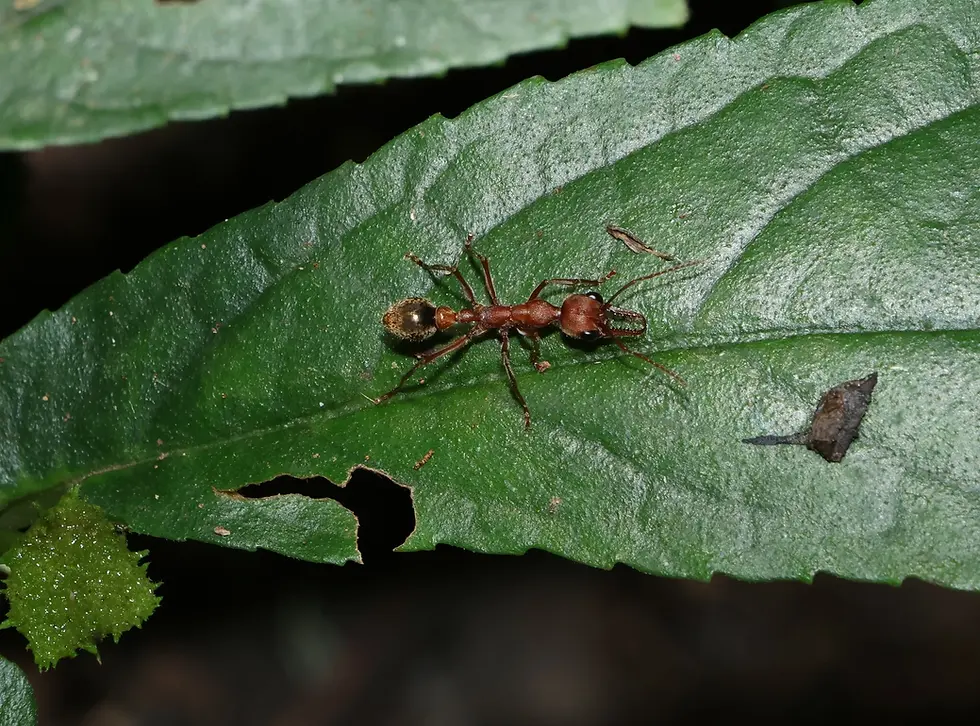
Appearance
Myrmecia midas is a medium-sized bull ant. Workers are around 13 to 15 mm long and queens 18 to 19 mm. The head and thorax are red and the gaster is black. The species was described by John Clark in 1951.
Where does it live?
Myrmecia midas lives along the eastern coasts of Australia. It nests at the base of trees and forages in the trees at night.

Eyes made for the dark
Myrmecia midas only goes out after dark, and its eyes show it. A study compared it with Myrmecia tarsata, which is active during the day. Myrmecia midas has about 3,590 facets in each eye with a diameter of about 31.6 µm, while Myrmecia tarsata has about 2,627 smaller facets. Larger facets catch more light. Read more in bull ant eyes.
Navigating by moonlight
Moonlight is polarised, just like sunlight, but it is a million times dimmer. Researchers found that Myrmecia midas can still read this pattern and use it as a compass on the way back to its nest. When they rotated the polarised light above the ants, the ants changed their direction to match. It was the first time an animal was shown to use polarised moonlight to navigate to a fixed place. It even works when only a crescent moon is in the sky, with about 20 percent of the full moon's signal. Read more in how bull ants find their way.
A loyal forager
Workers can live for more than a year. Each night, a forager walks to the same tree to look for food and comes back to the nest the same way. That makes these ants ideal for navigation research.
More about bull ants
Meet another night specialist, Myrmecia nigriceps, read about Myrmecia croslandi or see all bull ant species. Wondering whether you can keep a bull ant? Read can you keep bull ants.
Sources
Wikipedia. Myrmecia midas.
eLife digest, 2024. Navigating by night.
National Geographic, 2024. Bull ants navigate by polarized moonlight.
Ogawa et al., 2019. Frontiers in Ecology and Evolution.
Photos: © Greg Tasney, © Prissm


Comments