


Myrmecia nigriceps: The Black-Headed Bull Ant
Updated: 1 day ago
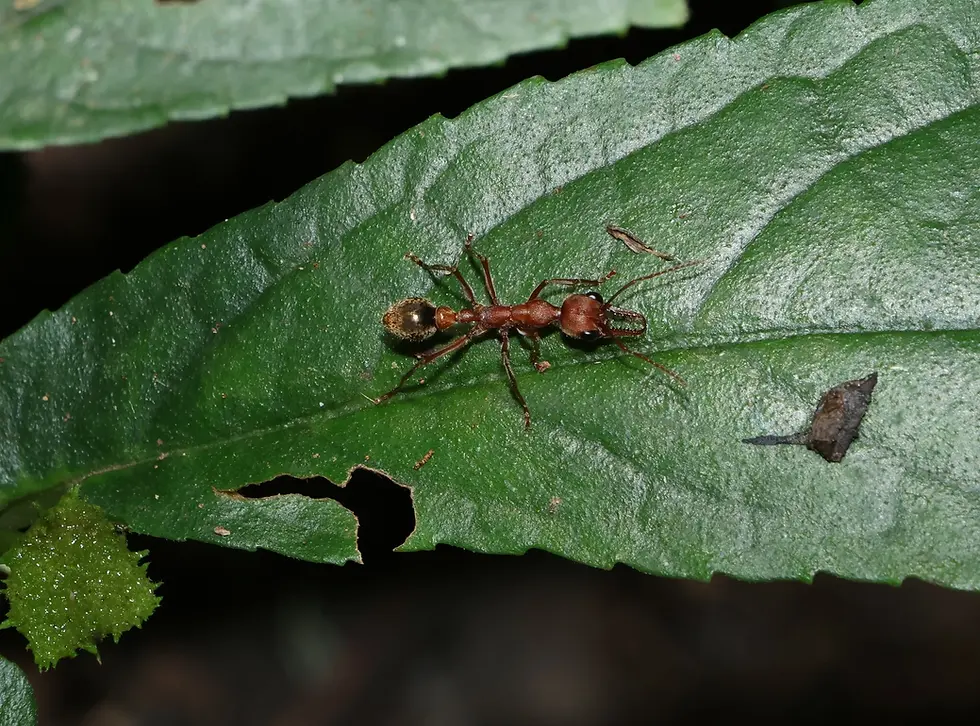
Myrmecia nigriceps is the black-headed bull ant. With its black head, red body and yellow legs, it is one of the most striking bull ants in Australia. It is also one of the most aggressive, and it is a true night specialist.

The black-headed bull ant
The name nigriceps comes from the Latin words niger (black) and caput (head). The species was described by Gustav Mayr in 1862. For a while it was treated as part of another species, until William Morton Wheeler made it a species of its own again in 1933.
Appearance
Workers are about 19 to 23 mm long, queens 24 to 26 mm and males 18 to 20 mm. Colonies also have smaller workers. The head and gaster are black, the thorax is red, and the legs and jaws are yellow.

Where does it live?
Myrmecia nigriceps is found across most of Australia, except the centre and the north coast. It lives in very different places, from deserts and coastal areas to woodland. The nest is often a mound decorated with small lateritic pebbles, but colonies also live under logs.
Built for the night
This species starts foraging about an hour before sunset and is active at dusk and at night. Of all Myrmecia species, it has the largest eye lenses and photoreceptors, which helps it see in low light. Read more in bull ant eyes.
Food
Adult workers mainly drink nectar. The larvae are fed insects and other invertebrates, including Camponotus ants. Not every prey gives up easily: some cockroaches can fight off an attack.
Behaviour
Myrmecia nigriceps is known as an extremely aggressive bull ant. Its venom, however, is relatively weak compared with other bull ants. Strangely enough, ants from other nests can sometimes walk into a colony without being attacked.
Colony life
Nuptial flights take place after rain, between December and March, often from hilltops. After the flight, the young queen does not seal herself in but keeps foraging while she raises her first workers. Workers can live for around 2.2 years. The species is also the host of a parasitic bull ant, Myrmecia inquilina, whose queens move into its nests. Read more in bull ant colony life.
Enemies
Even a bull ant has enemies. Echidnas dig into the nests, jumping spiders of the genus Zenodorus hunt the workers and blind snakes feed on the brood.
More about bull ants
Discover how bull ants find their way at night, meet Myrmecia midas or see all bull ant species. You can also read how bull ants hunt.
Sources
Wikipedia. Myrmecia nigriceps.
Wikipedia. Myrmecia (ant).
Photos: © Conner Margetts, © Prissm

Comments