


The Sugar Trick and Dish Soap Method: How to Gently Redirect Ants Indoors
Updated: Oct 14
If you've noticed an ant trail appearing along your kitchen wall or across a window ledge, you've seen one of the most efficient food-finding systems in nature. Ants don't wander randomly - they follow chemical signals, communicate through scent, and build reliable routes to food sources in a matter of hours. Understanding how this works is the key to redirecting them without any harm.
How Ant Trails Form
When a forager ant finds a food source, she carries a small amount back to the nest while releasing pheromones from a gland near the tip of her abdomen. Other workers detect this chemical trail and follow it. As more ants find the food and return, each one reinforces the trail. The stronger the food source, the more ants contribute, and the stronger the signal grows.
This is why a trail can appear overnight and hold steady for days. It has become self-reinforcing. But it also means the trail completely depends on that chemical signal - and both methods below work by interfering with it.
The Sugar Trick: Work With Their Instincts
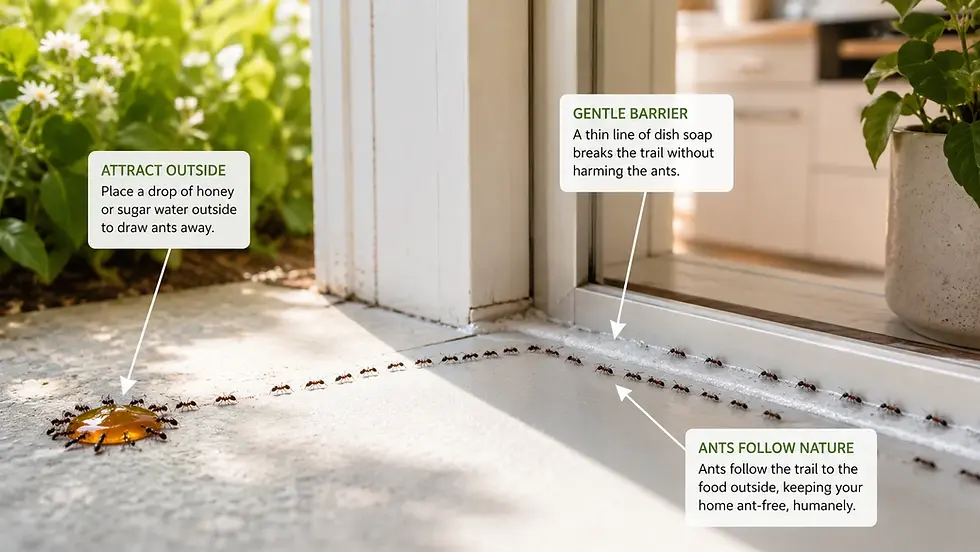
Foragers aren't exploring for its own sake - they stop the moment they find something worth collecting. You can use this to your advantage. Place a small drop of honey or sugar water right at the point where ants are entering your home, but on the outside. Foragers find the food immediately and start collecting it there. They have no reason to go further.
Over the next day or two, the pheromone trail concentrates at that entry point, and scouts that were venturing deeper into your home shift their focus to the easier source right at the door. You've given them what they want at the threshold, and the exploration stops. Sugar water is particularly effective for this since it is one of the primary energy sources ant colonies collect. This post on sugar water for ants explains why colonies value it so highly.
Once the foraging activity at the entry point settles down - usually within a day or two - seal the gap and remove the sugar source. Without reinforcement, the pheromone trail fades and the ants move on to other foraging routes.
The Dish Soap Line: Erase the Trail
Dish soap doesn't repel ants through smell - it breaks down the pheromone compounds in the trail itself. When ants reach a line of washing-up liquid, the chemical message they were following is simply gone. They lose orientation, mill around, and most turn back. There's no signal to follow and no reason to continue.
Apply a thin smear across doorsteps, window sills, or wherever you see consistent ant traffic. A finger, cotton bud, or soft brush all work fine. You don't need a thick layer - even a small amount is enough to break the trail. Reapply when it dries out or after cleaning the surface.
Using Both Together
The two methods work well in combination. Use the sugar trick at the entry point to concentrate and contain the trail outside. Add a dish soap line just inside the threshold as a backup in case any foragers push past. Most of the time the sugar is enough, but together they cover both possibilities.
Neither method causes any harm. The ants collect the sugar, take it back to the colony, and you've simply negotiated a boundary: food available outside, none inside. Once you've also sealed the physical entry points, the situation resolves on its own within a few days.
Don't Forget the Gaps
Both tricks manage the trail but don't remove the entry point. For a lasting solution, take a few minutes to check window frames, door seals, and any gaps around pipes or cables once the ants have calmed down. Sealing these means the cycle doesn't repeat next summer. We cover all of this in more detail in How to Ant-Proof Your Home Without Harming a Single Ant.


Comments