


How to Make the Perfect Test Tube Setup for Your Queen Ant
Updated: 7 days ago

The test tube setup is one of those things that looks simple but gets wrong more often than you would expect. A queen goes in, a bit of water, some cotton, done. Except not quite. The water type matters, the cotton technique matters, the tube size matters, and so does how often you look at it. We have made tens of thousands of test tubes at Esthetic Ants, and this guide covers everything we have learned along the way. Prefer watching? We also made a full video tutorial on this topic on our YouTube channel. This written guide goes deeper and adds extra detail, so they work well together.
Why the test tube setup works
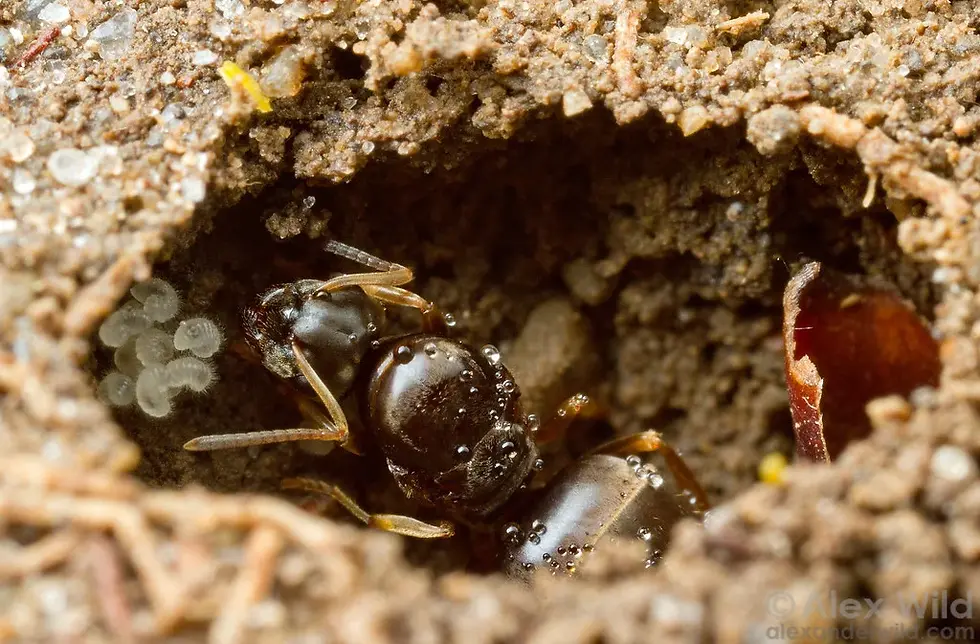
After a nuptial flight, a queen ant sheds her wings and goes looking for somewhere to start her colony. In the wild, she finds a small crack in soil or under a stone and seals herself in. The chamber is tiny, barely large enough to turn around, dark, and humid. She will not eat. She will not see daylight. She will raise her first workers entirely on her own reserves, including the dissolved wing muscles she no longer needs.
The test tube setup replicates those conditions. It gives a fully claustral queen darkness, a confined space, humidity from the water reservoir, and enough isolation to raise her first brood without stress. It is the most effective founding setup available to hobby keepers, and decades of experience across the ant keeping community backs that up.
What you need
The materials list is short: a test tube, clean water, a cotton ball, and a small syringe to fill the tube precisely. No substrate, no decoration, no heating required. The simplicity is part of what makes it so reliable. But each of those three things has more to it than the short list suggests.
Choosing the right test tube
Bigger is not better here. A queen in a large tube has too much open space, which makes humidity harder to maintain and makes her feel exposed rather than secure. In the wild, founding chambers are just large enough for a queen to turn around in. Your tube should reflect that.
At Esthetic Ants we standardise on 16mm diameter tubes. For a single founding queen such as Lasius niger we use a 100mm length. For a queen with her first workers, the 150mm tube gives more breathing room. We particularly like our Italian 150mm tubes, which have a double-walled construction that makes them significantly more durable than standard single-wall options.
We stock clear test tubes individually if you only need one or two, and a box of 70 to 93 test tubes if you are setting up multiple queens or want plenty of spares on hand.
On the plastic versus glass debate: glass gives better visibility, and many experienced keepers prefer it for that reason. But plastic does not shatter when dropped, does not conduct cold as readily, and holds the cotton more securely. We prefer plastic for everyday use. Both work fine if used correctly, so go with what suits your situation.
Water: the most important material
Use clean, plain water. Not sugar water, not flavoured water. Sugar in the reservoir is a common beginner mistake and one that causes serious problems. The sugar feeds bacteria and mold, and once that starts in a sealed tube it is very difficult to stop.
Tap water is fine in countries where it is safe to drink directly from the tap. If your tap water is not drinkable, use bottled water or distilled water instead. This sounds like overkill but it genuinely helps prevent bacterial growth and extends how long the tube stays clean.
Over time, the water in a test tube can change color. Green water is commonly caused by algae and in our experience does not seem to affect colonies significantly. Pink or reddish water is something we have seen correlate with faster colony decline, though this is purely based on years of observation and not scientific research. The safe general rule: if the tube becomes heavily discolored, smells bad, or shows aggressive mold growth near the queen chamber, prepare a fresh tube.
Water pH can also drift over time. Ant waste, CO2 from respiration, microbial growth, and minerals from the water itself can all push the pH more acidic or more alkaline. There is no easy way to test this in a sealed tube, so the best approach is simply to start clean and replace the setup if conditions deteriorate.
Cotton: more important than it looks
Any cotton works as long as it is dense and compact. Loose, fluffy cotton is harder to work with and more likely to let water leak through or leave gaps the ants can squeeze past. We have used makeup remover pads for years. Dense cotton balls that fit snugly in the tube are even better and simpler to work with.
Here is a tip that most guides skip: wash your hands before touching the cotton, and ideally sanitize them with isopropyl alcohol and let them dry before you start. Your skin carries oils and bacteria that transfer to the cotton and can negatively affect how long the tube stays clean. If you are only setting up one tube it might feel excessive. But if that is your only colony, it is worth the extra thirty seconds.
How much water to add
This depends on the species and stage of the colony. There is no universal answer, which is one of the things that makes ant keeping more interesting than it first appears.
For a founding claustral queen raising her first workers alone, more water is appropriate. She will be in the tube for months without it being replaced, so a larger reservoir gives her margin. For a young colony that you will be actively feeding, less water gives you more room and reduces the risk of spills. For semi-claustral queens, which need to forage during founding, less water so the queen chamber is accessible.
For Lasius niger, a reliable beginner species, we fill the tube a little over one third. Some species are dryland dwellers and need a very different setup. Tetraponera rufonigra, for example, does best in an almost dry tube with just a small drinking reservoir. Always research the specific requirements of your species before setting up the tube.
Claustral vs semi-claustral queens
Understanding which type of queen you have changes how you care for her from day one.
Fully claustral queens seal themselves away after the nuptial flight and use stored energy from their fat reserves and dissolved wing muscles to raise the first workers. They do not need food and should not be disturbed. Lasius niger is a fully claustral species. Most common European ant species are.
Semi-claustral queens cannot survive the founding stage on stored reserves alone. They need to leave the tube and forage for food to feed themselves and their developing brood. These queens need a small outworld connected to their test tube from early on, and they need regular small food offerings. Some Camponotus species fall into this category. If you put a semi-claustral queen in a fully sealed tube with no food access, she will struggle.
Step by step: putting it all together
Fill the tube with your chosen amount of water first. A 3ml syringe is ideal for this, it gives you precise control over exactly how much water goes in, and it keeps your hands away from the inside of the tube. A pipette, bottle, or tap works too if a syringe is not available.
The most common failure here is the air bubble problem. If you push the cotton down slowly, the capillary action of the wet cotton draws water up rapidly before the cotton is fully seated, creating an air gap below the plug. This gap will cause the tube to drip. The solution is to insert the cotton at the entrance and then push it down quickly in one motion. Once it is roughly in place, you can nudge it gently to the correct depth.
What does correct depth look like? Picture three tubes: the first has cotton sitting too high, not quite touching the water. The queen chamber is dry and she cannot drink. The second has the cotton pushed too far down into the water. The tube will leak and the chamber will flood. The third has the cotton sitting exactly at the water line, the surface just touching so moisture passes through but no open water is exposed. That third tube is your target.
If you are not happy with the result, make a new tube. This step is too important to work around with a suboptimal setup.
To add the queen, hold the open end of the tube close to where she is sitting and use the closing cotton to gently guide her in. Once she is inside, press the closing cotton firmly into the entrance and you are done.
Keeping your queen comfortable
Cover the tube. A piece of paper, foil, or a fabric sleeve is enough. Founding queens naturally seek complete darkness, and a covered tube reduces stress significantly. Many keepers find that uncovered queens spend more time trying to escape and less time laying eggs.
Leave the tube alone as much as you can. Checking on your queen every day is tempting but it stresses her. In severe cases, excessive disturbance and especially shining a phone light directly into the nest can cause a queen to eat her own eggs and larvae. Check once a week at most during founding, and only briefly.
Keep the tube at a stable room temperature, roughly 20 to 25 degrees Celsius for most European species. Avoid placing it in direct sunlight. A glass or plastic tube in direct sun heats up very fast and can kill a colony in minutes. Use a small tube rack or holder to keep things tidy and prevent the tube from rolling off a surface.
Feeding in the test tube
For fully claustral queens, do not feed until the first workers have arrived. Claustral queens have energy reserves specifically for the founding period, and introducing food into the tube before workers are present mostly grows mold and bacteria.
For semi-claustral queens, connect a small outworld and offer tiny amounts of protein and sugar water regularly. Keep portions very small. Leftover food in a warm, humid space spoils quickly and the resulting mold can harm the queen.
Once first workers have emerged, they will begin foraging. A small outworld connected to the test tube gives them space to find food while the queen stays in the safety of the tube.
When to replace the test tube
Some discoloration is normal and not a reason to panic. A slightly green tinge from algae is common and does not usually harm the colony. The situations that actually call for a new tube are: the water is running dry, mold is spreading aggressively toward the queen chamber, the cotton has failed, or the tube is leaking.
When you do move a queen, do it as calmly and quickly as possible. Have the new test tube ready before you open the old one. Use the same guiding technique as the original setup, close the entrance quickly, and leave her to settle. Moving a queen is stressful. Keep it rare.
When to move to a formicarium
The most common mistake at this stage is moving too early. A large empty nest is not exciting for a small colony. It makes humidity harder to maintain, food harder to find, and the colony harder to observe. Wait until the colony is clearly outgrowing the tube, not just until you have a handful of workers.
For most species the transition happens naturally. Workers start foraging, the tube fills up, and it is clearly time for more space. The easiest way to make that transition is with the Mini Outworld V2 which has four built-in test tube slots. You simply slide the tube into one of the slots and the colony can move between the tube and the outworld at their own pace, no modifications, no extra parts needed.
The easiest next step: the Mini Outworld V2
The Mini Outworld V2 is the easiest way to give a growing colony more space while keeping the test tube as their home base. It has four dedicated test tube slots built in, so you just slot in the tube and the ants can explore the outworld whenever they are ready. No separate connector needed, no drilling, no modifications. It is compact, escape-proof, and works with our standard 16mm test tubes right out of the box. For most beginner colonies, the Mini Outworld V2 is the natural next step after the founding tube.
The test tube setup is where almost every ant colony starts. Getting it right gives your queen the best possible conditions to raise her first workers and build a colony that will grow for years. Everything you need, test tubes, cotton balls, syringes, and the Mini Outworld V2 is available at estheticants.com. If you have questions about your specific species or setup, our Discord community is a great place to ask.


Comments