


Safari Ants: Africa's Driver Ants, Seen in Uganda
Bijgewerkt op: 1 dag geleden
On our trip to Uganda we went on a real ant safari: a walk through the forest of Kalangala, on the Ssese Islands in Lake Victoria. One of the ants we found there is famous all over Africa. Dorylus wilverthi is a driver ant, better known to many people as the safari ant. Here is what makes these blind hunters, with colonies of millions, so special.
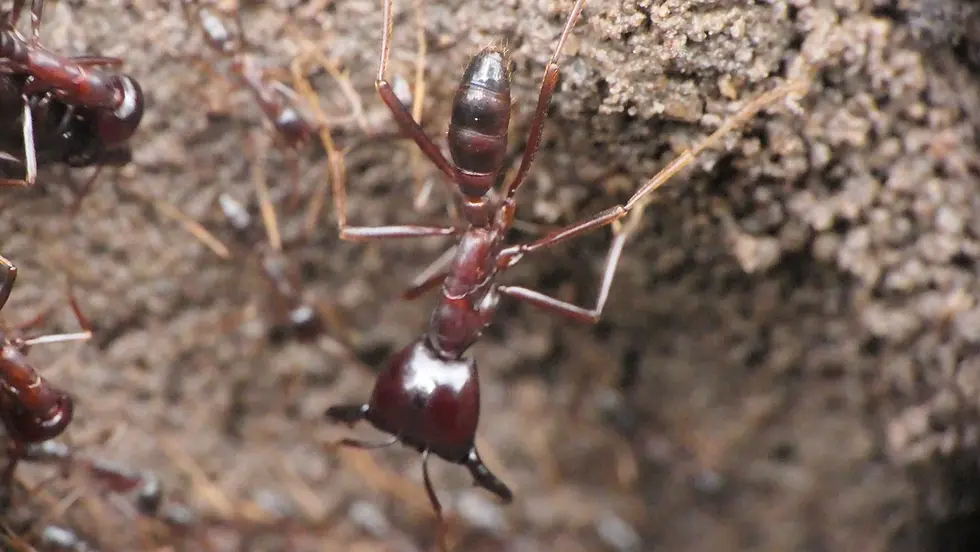
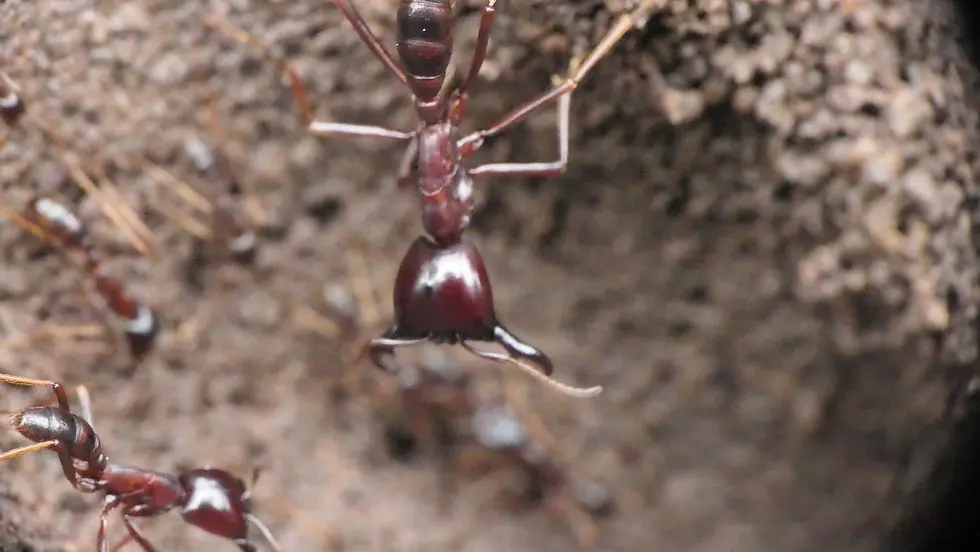
We spotted them where a new road had been cut into the forest: a long column of workers crossing the bare soil, guarded by large soldiers with long legs and curved jaws.

Driver ant, safari ant or siafu?
All three names point to the same group of ants: the genus Dorylus. In East Africa they are called siafu, a Swahili word, and English speakers call them driver ants or safari ants. There are about 60 Dorylus species. Most live in Central and East Africa, and the genus reaches into southern Africa and tropical Asia. Together with the army ants of the Americas, they belong to the subfamily Dorylinae.
Dorylus wilverthi, the species we found
Dorylus wilverthi was described in 1899 by the Italian ant expert Carlo Emery, from specimens collected in what is now the Democratic Republic of Congo. It lives in intact rainforest in Central and East Africa, including Uganda, Kenya, Rwanda, Cameroon and Ivory Coast. A colony has one queen and on average an estimated 10 to 20 million workers. In the Kakamega Forest in Kenya it shares the forest with a related driver ant, Dorylus nigricans molestus, and the two species occasionally hybridize, although hybrid workers are rare.

Blind hunters in their millions
Driver ants are completely blind. They find their way and communicate with scent trails. The workers come in many sizes, from small workers to soldiers with large heads and sharp, curved jaws. They hunt as one huge group and eat almost any small animal they can overpower, with earthworms as an important part of the menu. Several species also raid termite mounds and carry the termites back home. Read more in how driver ants hunt.
A colony that keeps moving
A driver ant colony does not build a permanent nest. It lives in a temporary underground camp, called a bivouac, for anything from a few days to a few months. When food runs low, the whole colony moves on in long marching columns. Those columns are slow, at about 20 metres an hour, but impossible to miss.
A giant queen and sausage flies
Driver ant queens never have wings and never make a nuptial flight. They are among the largest ants on Earth: depending on their condition, queens of the genus measure about 4 to 6 cm. Guinness World Records lists a related species, Dorylus fulvus, as the largest ant in the world. A queen can lay several million eggs a month.
The males look completely different. They have wings and a thick, sausage-shaped abdomen, which is why people in Africa call them sausage flies. A male follows the scent trail of a colony, the workers tear off his wings, and he is taken to a young queen. In Dorylus wilverthi a new queen mates inside the nest with many males, often 10 to 30. She then leaves on foot with part of the workers to form a new colony.
Are safari ants dangerous?
A bite from a driver ant soldier is painful and leaves two small puncture wounds. They rarely sting. Because the columns move slowly, you can easily step aside. They are mainly a danger to animals and people that cannot move out of the way. At the same time, they help farmers by eating insects and other pests. In parts of East Africa people even used the soldiers as emergency stitches: the ant bites both sides of a wound, and then its body is broken off while the jaws stay in place.
Can you keep safari ants?
No. A colony consists of millions of ants, keeps moving and has a queen that never flies, so there is no way to keep driver ants at home. If you would like an African species in a formicarium, look at harvester ants like Messor cephalotes instead. Or try Messor barbarus, a harvester ant from Southern Europe and North Africa.
Sources
Wikipedia. Dorylus.
AntWiki. Dorylus wilverthi.
Guinness World Records. Largest ant.
Kronauer, D.J.C. et al., 2007. Extreme queen-mating frequency and colony fission in African army ants. BMC Evolutionary Biology 7: 56.
Butler, I.A., Peters, M.K. and Kronauer, D.J.C., 2018. Low levels of hybridization in two species of African driver ants. Journal of Evolutionary Biology 31: 556 to 571.
Photos: © Esthetic Ants


Opmerkingen