


African Stink Ant: How Paltothyreus tarsatus Lives
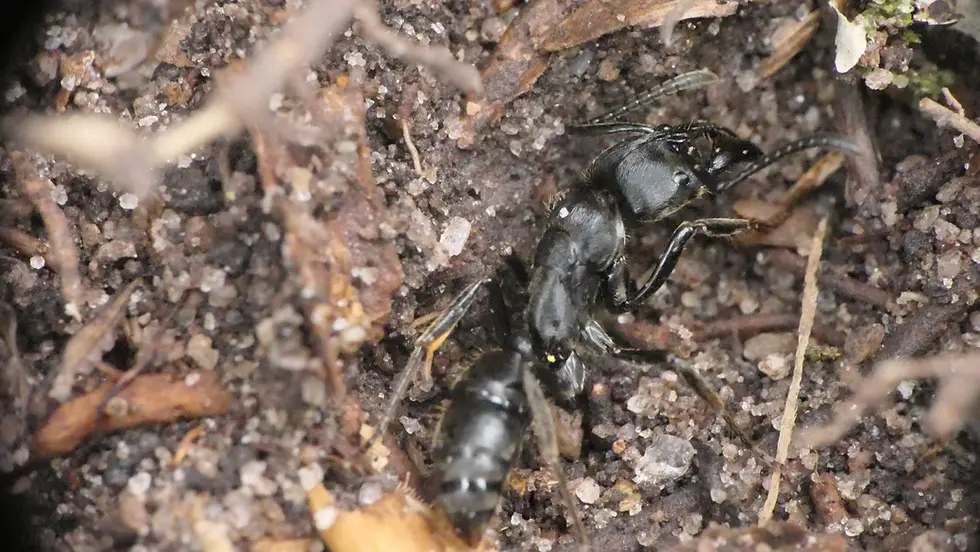
On our ant safari in Uganda, one ant stood out right away: a big, shiny black ant walking alone over the forest floor. It was Paltothyreus tarsatus, the African stink ant. It is one of the largest ants in Africa, it hunts termites, and it has a very good reason to smell like rotten eggs. Here is how this ant lives.

A big ponerine from Africa
Paltothyreus tarsatus is the only species in its genus. It was first described in 1798 by the Danish entomologist Johan Christian Fabricius, under the name Formica tarsata. It belongs to the Ponerinae, a subfamily of mostly hunting ants with a real sting. Workers are about 17 to 20 mm long and completely black, with fine grooves on the head and thorax. Queens are a bit larger and have wings. The species lives across most of sub-Saharan Africa, in both savanna and forest.
Why it smells like rotten eggs
Pick up or disturb a worker and you will smell it right away. The mandibular glands in the head release a mix of sulphur compounds that smells like rotten eggs. That smell has a clever use. The nests are a network of shallow tunnels, and these sometimes collapse. A worker that gets buried releases the smell, and her nestmates follow it to dig her out. The venom gland also contains bitter-tasting compounds.

A termite hunter
The African stink ant is a predator. Most of its prey are arthropods, and termites are at the top of the menu, especially the large Macrotermes species that build big mounds. Millipedes, beetles and other ants such as Camponotus are taken too. In Benin it was even seen raiding the nests of weaver ants (Oecophylla longinoda).
Workers usually hunt alone. When a scout finds a big prey item or a lot of termites, she can call nestmates with a scent signal from a gland on the underside of her gaster. On the way home, workers sometimes pass the prey on to each other.
Finding the way by looking up
In 1980 the ant researcher Bert Hölldobler discovered that the African stink ant navigates by looking at the tree canopy above it. The pattern of leaves and gaps against the sky works as a map. When the canopy above a worker was changed, she lost her way. This was the first time this kind of orientation was described in ants.

Giant underground nests
A colony does not live in one central nest. It builds a network of shallow tunnels with several entrances, often surrounded by dug-out soil and the remains of prey. Foragers travel safely underground and come up far from the centre of the nest. On the surface they usually stay within a few metres of an exit. In a study in Ivory Coast, colonies had on average about 1,500 workers, and a few had more than 5,000. That is a lot for a ponerine ant.
Queens found new colonies without sealing themselves in: they leave the nest to hunt while they raise their first workers.
A frog that lives with the ants
One of the strangest facts about this ant is its housemate. In West Africa, the frog Phrynomantis microps is sometimes found living inside the nests. Its skin produces a substance that stops the ants from attacking it, so the frog has a safe, moist place to hide in the dry season.
Does it sting?
Yes, like most ponerine ants it has a working sting, and a big worker can give a painful one. In the forest it usually walks away from you, so with some care it is easy to watch without being stung.
Can you keep the African stink ant?
It is rarely kept. A colony needs a lot of space for its tunnel network, plenty of live prey and a warm, humid setup, and the queens need to be fed while they found a colony. We do not sell this species. For us, seeing it in the wild was the best way to meet it. Read the whole story in Ant Safari in Uganda, and meet another African hunter in our post about safari ants and driver ants.
Sources
Wikipedia. Paltothyreus.
AntWiki. Paltothyreus tarsatus.
Braun, U., Peeters, C. and Hölldobler, B., 1994. The giant nests of the African stink ant Paltothyreus tarsatus. Biotropica 26: 308 to 311.
Hölldobler, B., 1980. Canopy orientation: a new kind of orientation in ants. Science 210: 86 to 88.
Crewe, R.M. and Fletcher, D.J.C., 1974. Ponerine ant secretions: the mandibular gland secretion of Paltothyreus tarsatus. Journal of the Entomological Society of Southern Africa 37.
Rödel, M.O. and Braun, U., 1999. Associations between anurans and ants in a West African savanna. Biotropica 31: 178 to 183.
Photos: © Esthetic Ants

Opmerkingen