


How Driver Ants Hunt: Inside a Safari Ant Raid
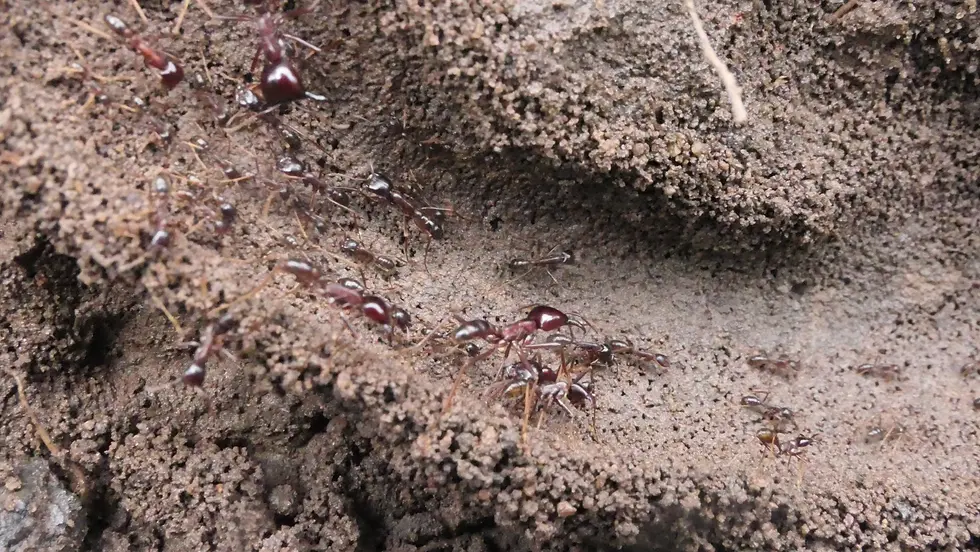
On a new road cut into the forest of Kalangala, Uganda, we watched a column of driver ants (Dorylus wilverthi) stream across the bare soil. Big soldiers stood along the edges with their jaws wide open, while thousands of smaller workers hurried past in the middle. It was a raid in progress. In our post about safari ants and driver ants we explained what these ants are. Here we look at how they actually hunt.

Hunting without eyes
Driver ant workers are blind. Everything in a raid runs on scent. The first workers lay a chemical trail, the ants behind them follow and strengthen it, and within minutes a thin line becomes a busy road. Because the whole colony follows the same chemical signals, millions of ants can move and hunt as if they were one animal.
The swarm raid
Many Dorylus species hunt mostly underground or in the leaf litter. The driver ants of the subgroup Anomma, which includes Dorylus wilverthi, are famous for hunting above ground in swarm raids. From the nest, a column runs out to a wide front of ants that sweeps over the forest floor. Anything that cannot get out of the way in time, from earthworms and insects to spiders and other small animals, is overwhelmed, cut up and carried back along the column.
A swarm can contain hundreds of thousands of ants. It moves slowly, but it is so thorough that many animals simply flee in front of it.
Soldiers guard the road
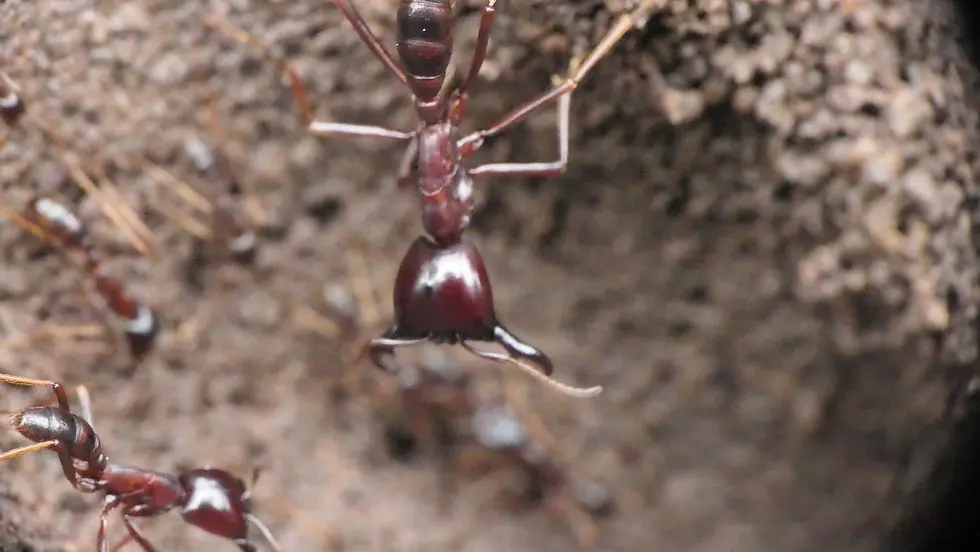
That is what we saw on Kalangala. The largest workers, the soldiers, do not carry prey. They stand along the sides of the column with their heads raised and their sharp, curved jaws open, ready to bite anything that comes too close. Smaller workers run in the protected middle, carrying prey and brood. A bite from a soldier is painful, and once the jaws are in, they do not easily let go.

What is on the menu?
Driver ants are generalists. Earthworms are an important part of their diet, and researchers on Mount Kenya studied how swarm raids affect earthworm numbers in the forest soil. Insects, spiders and other invertebrates are taken too. Animals that cannot move away, such as injured or tied up animals, can be in real danger.
Termites are a special case. Termite mounds are well defended, so raids on them are rarely seen. In 2005, researchers in Nigeria watched driver ants (Dorylus rubellus) raid a nest of the mound-building termite Macrotermes subhyalinus. They estimated that about 220,000 termites were carried home along a single trail, and maybe half a million over three trails. The colony took so much that some prey started to rot in the nest. Shortly afterwards the ants moved to a new nest 67 metres away.
Day shift or night shift
Driver ants do not stick to one time of day. In a study of Dorylus molestus in Kenya, colonies in the forest hunted during the day in dry weather. Colonies living outside the forest, where it is hotter and drier, hunted at night and were usually back in the nest before nine in the morning. On cloudy or rainy days they hunted during the day as well.
Moving house
After raiding the same area for a while, a colony moves on. Unlike the army ants of the Americas, which switch between a nomadic and a resting phase on a fixed schedule, driver ants move house at irregular times. Their temporary nests are underground and can reach more than a metre deep. Prey populations recover quickly after a raid, so the forest is not emptied for good.
Birds that follow the ants
A driver ant swarm is good news for some birds. Insects and worms that flee from the ants are easy to catch. In Equatorial Guinea, researchers found that birds such as the white-tailed ant thrush and the fire-crested alethe specialise in following driver ants. They check nest entrances in the morning to see where the ants go, and the ticking sound of a swarm and the calls of other birds help them find the action.
Watching a raid safely
If you ever see driver ants in Africa, watch from the side and never stand in or next to the column. Check your shoes and legs regularly, because soldiers climb quickly and their bite hurts. The column moves slowly, so you can easily step back and enjoy one of the most impressive sights in the ant world. Read about the rest of our trip in Ant Safari in Uganda.
Sources
Wikipedia. Dorylus.
Schöning, C. and Moffett, M.W., 2007. Driver ants invading a termite nest. Biotropica 39: 663 to 667.
Schöning, C. et al., 2006. Driver ants in fragmented forests of Kenya. Journal of East African Natural History 95: 163 to 179.
Schöning, C., Csuzdi, C., Kinuthia, W. and Ogutu, J.O., 2010. Influence of driver ant swarm raids on earthworm prey densities in the Mount Kenya forest. Insectes Sociaux 57: 73 to 82.
Science News, 2023. Some African birds follow nomadic ants to their next meal.
Photos: © Esthetic Ants


Opmerkingen