


Paraponera clavata: How the Bullet Ant Lives
Paraponera clavata is better known as the bullet ant, the ant with the most painful sting in the world. That sting gets all the attention, but the ant behind it leads an interesting life in the rainforests of Central and South America. In this post we look at where Paraponera clavata lives, how a colony works and what it eats. Curious about the sting itself? Read our post on the bullet ant sting.
Name and family
Paraponera clavata was described in 1775 by the Danish entomologist Fabricius. It is the only living species in its genus, and that genus is the only one in its own subfamily, the Paraponerinae. A close relative, Paraponera dieteri, was found preserved in Dominican amber and lived millions of years ago. Where the ant lives, it goes by many names: bala ("bullet") in Costa Rica, hormiga veinticuatro ("24 hour ant") in Venezuela, after the day of pain that follows a sting, and tocandira or tucandeira in Brazil.
Where does it live?
Paraponera clavata lives in humid lowland rainforest, from Honduras and Nicaragua through Central America down to Venezuela, Colombia, Ecuador, Peru, Bolivia and Brazil. Most colonies are found at low altitude, but the species turns up higher in the mountains now and then. Where it occurs it is common: field studies in Costa Rica and Panama found around four nests per hectare of forest.
Appearance
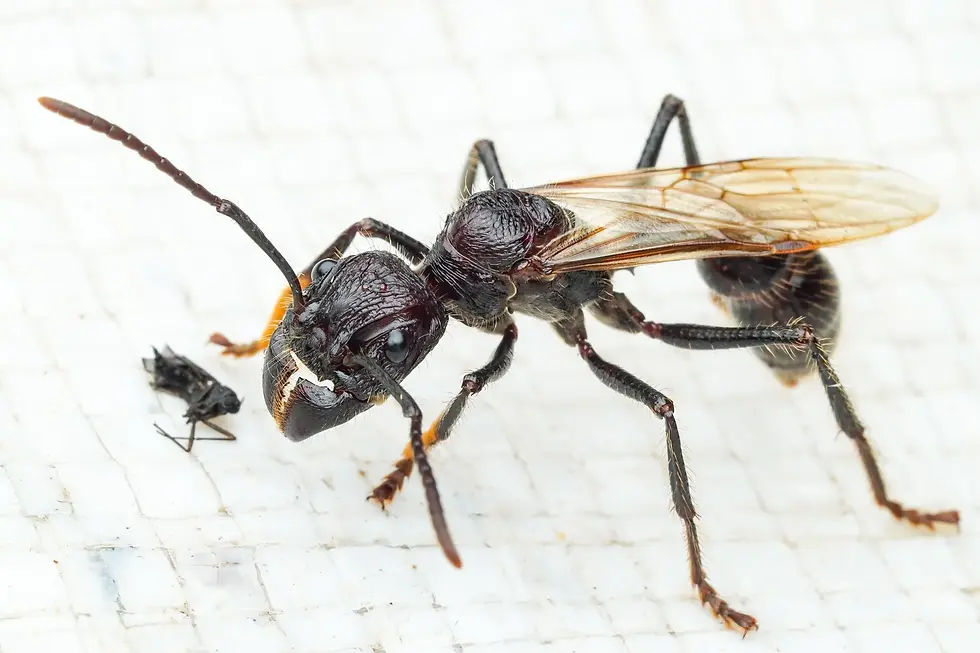
This is one of the largest ants in the world. Workers are roughly 18 to 30 mm long, stout and reddish black, and look a bit like a wingless wasp. They have strong jaws and a large sting at the tip of the gaster. The queen is hardly larger than the workers and looks almost the same, which makes her surprisingly hard to spot in a colony.
Colony and nest
Colonies nest in the ground at the base of a tree, and sometimes in piles of humus high up in the canopy. A large survey in Panama found nests under dozens of different tree species, so the ants do not seem very picky about their tree. For such a large ant, the colonies are small: usually a few hundred workers, sometimes more than two thousand, with a single queen.
Starting a new colony

After mating, a young queen starts a new colony on her own. Many ants seal themselves in and live on their body reserves until the first workers arrive. A bullet ant queen cannot do that: she has to leave her nest and hunt for food until her first workers are adult. Males are often attracted to lights at night, which is how many of them end up in research collections.
Food and foraging
The workers climb the nest tree and forage in the canopy, all the way up to the highest branches. Very little foraging happens on the forest floor. Nectar is the most common food they bring home, carried as a droplet between their jaws. They also hunt small insects and other arthropods and bring back bits of plants. Workers often forage alone, but they can guide a nestmate to a good food source by tandem running, where one ant follows right behind the other. You can read more about the food of ants in general in what do ants eat.
Defence
When the nest is disturbed, workers first make a squeaking sound by rubbing two body parts together. This is called stridulation, and it works as a warning. If that does not help, they sting. The venom contains poneratoxin, a toxin that keeps pain nerves firing for hours. We explain how that works in our post on the bullet ant sting.
Enemies
Phorid flies: the tiny fly Apocephalus paraponerae is drawn to injured workers within minutes. It lays its eggs in the wounded ant, and the larvae grow inside it.
Zombie fungus: a fungus of the genus Ophiocordyceps makes infected workers climb a tree trunk and die there, firmly attached, so its spores can rain down on the forest floor.
Toads: cane toads have been seen eating bullet ants at a rate of up to one ant per minute.
The bullet ant and people
For the Sateré-Mawé people in Brazil, the bullet ant is part of a famous coming-of-age ritual, read more in the bullet ant glove ritual. Want more short facts? See 12 bullet ant facts. And if you are wondering whether you can keep one at home, read can you keep a bullet ant.
Sources
AntWiki. Paraponera clavata.
Belk, M. C. et al., 1989. Nest tree selectivity by the tropical ant, Paraponera clavata. Biotropica.
Photos: © Jonghun Park


Comments