


White Ants Are Not Ants: The Edible Termites of Uganda
Bijgewerkt op: 1 dag geleden
Ask someone in Uganda what "white ants" are and they will know immediately. Ask someone in Europe and you will likely get a confused look. The name is misleading, the insects are delicious, and the story behind them is a good example of how differently people across the world relate to insects as food.
White ants are not ants
Despite the name, white ants are not ants at all. They are winged termites, specifically the alate caste that leaves the colony during the rainy season to start new colonies. The name comes from their white wings, which are clearly visible as they swarm in large numbers at dusk. Once the wings drop after landing, the insects look nothing like ants. Read more about the difference between ants and termites.
Termites and ants are only distantly related. Termites are closer to cockroaches than to ants. They live in large underground colonies governed by a queen and are well known for eating wood and plant matter. In Uganda, the edible species emerge in massive swarms from their mounds and are collected as food. Termites do not sting, so collecting them is not dangerous.
There is a fun twist in the language too. In Luganda, the main language around Kampala and the islands of Lake Victoria, ants and termites share the same name: enswa. So the confusion is not only an English one.

When and where they appear
White ants appear during the rainy seasons, most commonly in April and May, with a smaller emergence sometimes occurring in November. The trigger is rain and humidity, which signals to the alates inside the mound that conditions are right to take flight. The swarms happen in the evening and can be intense, with thousands of termites emerging from a single mound within a short time.
They swarm in both rural villages and urban areas. You do not need to be in the countryside to encounter them. Termite mounds exist across Uganda, and the evening emergence happens wherever the mounds are.
How they are collected
Collection is straightforward. People position themselves at the exit holes of the termite mound and pick up the termites as they emerge. Since the insects are flying toward light and warmth, some collectors use lamps or fires to attract them. A container fills up quickly during a good swarm.
It is both a household activity and a small business. Families collect together in the evenings when people are free from work. Those who collect more than they need sell the surplus at local markets. For people without time to wait at a mound, buying from the market is the straightforward alternative. During peak season the price is very low, and out of season a small quantity costs around 500 Ugandan shillings per teaspoon.
How they are prepared and what they taste like
Before cooking, the wings are removed. This happens naturally during roasting or can be done by hand beforehand. The most common preparation is dry roasting in a pan without oil. The heat causes the shell to crisp up, resulting in a crunchy texture and an earthy, slightly smoky smell that has been described as organic and similar to lightly burnt wood.
A second common use is pounding the roasted termites and mixing them into groundnut paste, where they become part of a sauce served over a main meal. In this form the distinct taste fades, but the smell remains. Eaten whole and roasted, the flavour is fatty and crunchy with no sharp or sweet notes.
Nutrition and cultural significance
White ants are widely recognised in Uganda as a good source of protein. Research into edible insects more broadly confirms this: termites are rich in protein, fat, and various micronutrients, making them a nutritionally dense food that is freely available during the season.
They carry cultural weight too. In Uganda's clan system, animals serve as totems, and members of a clan do not eat their totem animal. People who belong to the enswa clan, named after the white ant, do not eat them. This is not about taste or availability but about cultural identity and the clan system that has governed social organisation in Uganda for generations.
Insects as food versus insects as pets
The gap between how insects are viewed in Uganda and in much of Europe is striking. In Uganda, insects like white ants and grasshoppers are simply food, seasonal and nutritious, collected the same way you might pick fruit. In the Netherlands, ants are kept in formicariums, observed, cared for, and given names.
Neither perspective is more correct than the other. They reflect different histories, different ecologies, and different relationships with the natural world. What is interesting is how much the two worldviews can learn from each other. Europeans are slowly beginning to accept insects as a sustainable food source. And in parts of Uganda and across Africa, keeping animals as companions is becoming more common too.
As one Ugandan perspective on trying unfamiliar food puts it: in Africa we really do not find it strange if someone does not eat what we eat, but we always request them to taste. Maybe they would like it.
That openness is something worth carrying into any conversation about insects, whether you are looking at them through a glass panel or cooking them in a pan.
More from Uganda
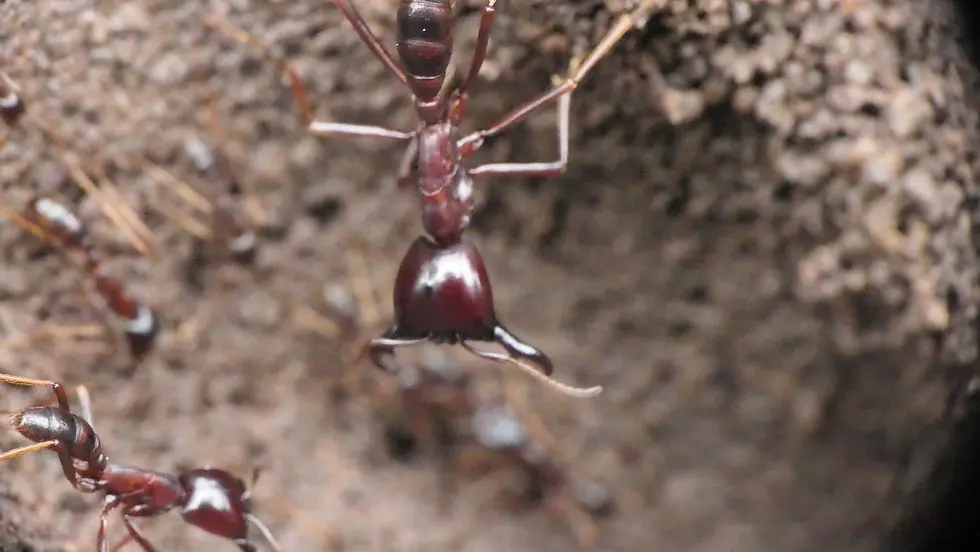
On our trip we also went looking for real ants. See what we found in Ant Safari in Uganda, and read about the famous safari ants and driver ants.
Photo: © Esthetic Ants


Opmerkingen