


Polyrhachis dives: 10 Facts About the Lesser Weaver Ant
Polyrhachis dives is a shiny black ant from Asia that builds its home with silk. Keepers know it as the lesser weaver ant, and once you have seen a colony stitch a nest together, it is easy to understand why it has fans all over the world. Here are ten facts about this species, from the spines on its back to its place in Chinese medicine. Want to keep it yourself? Our Polyrhachis dives care guide explains the practical side.
1. Its larvae are the silk factory
Adult Polyrhachis dives workers cannot make silk. Only the larvae can. When the colony builds, a worker picks up a larva, holds it gently in its jaws and moves it back and forth between two leaves or twigs. The larva releases a thin silk thread, and layer by layer the gap is closed. In other words, the larvae work as living glue tubes, and the adults decide where the glue goes.
2. It is called the lesser weaver ant for a reason
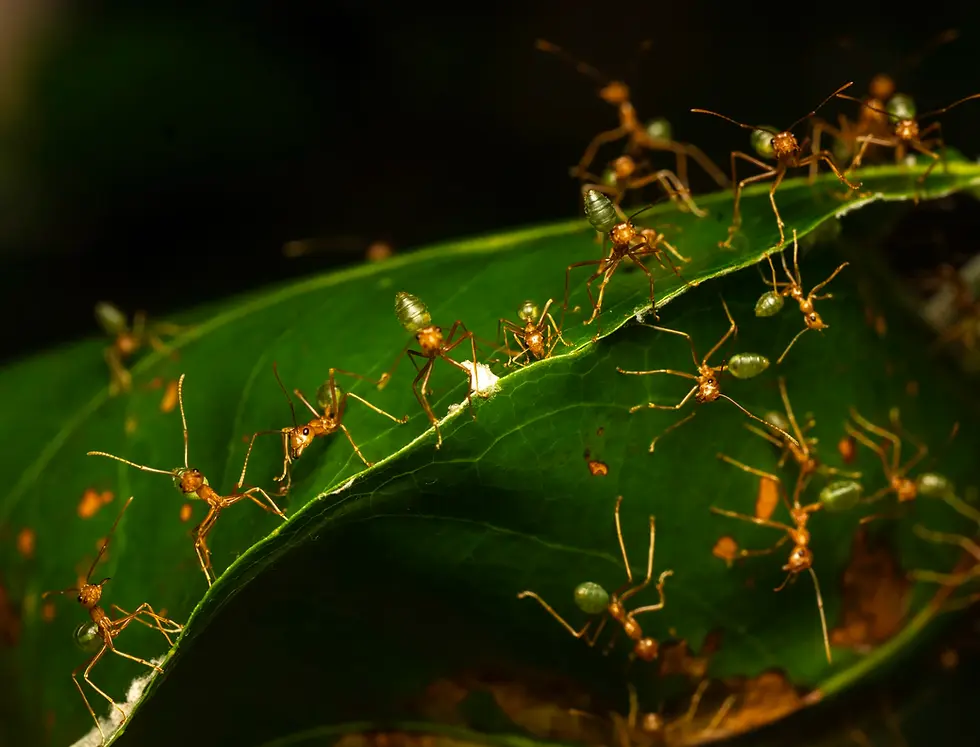
The famous weaver ants belong to the genus Oecophylla. They pull living leaves together and turn them into large green tents. Polyrhachis dives uses the same silk trick, but it is far less picky. Dead leaves, twigs, grass, bits of bark and plant fibres all go into the nest, often mixed with a papery carton. The result looks messier than an Oecophylla nest, but it is just as clever. You can read more about the true weaver ants in our Oecophylla smaragdina facts.
3. One nest can hold many queens
Polyrhachis dives is strongly polygynous, which means a single wild nest can contain many queens living side by side. That is one reason a colony can take over a bush or a row of shrubs so quickly. For keepers it is good news: colonies with two or three queens usually live together without trouble, something that does not work with many other species.

4. The name means rich
The genus name Polyrhachis comes from Greek and refers to the many spines on the back of these ants. The species name dives is Latin for rich or wealthy. The British entomologist Frederick Smith described the species in 1857, and it has carried the name ever since.
5. Its spines work as armour
Look closely and you will see a pair of hooked spines on the back of the thorax and more spines on the petiole, the small segment between the thorax and the abdomen. They make the ant an uncomfortable mouthful for spiders, birds and lizards. Under a macro lens, the shiny black body and those curved hooks make it one of the most photogenic ants you can keep.
6. No sting, but a bite and a spray of acid
Like all ants in the subfamily Formicinae, Polyrhachis dives has no sting. It defends itself by biting and by spraying formic acid from the tip of its abdomen. People who live alongside it in Okinawa know the bite well. It is harmless for a keeper, but you will notice it when you disturb a busy colony.
7. It farms honeydew
In nature a large part of its diet is honeydew, the sugary liquid produced by aphids, scale insects and other sap suckers. The ants protect these insects and collect the honeydew in return. In a field study in southern China, Polyrhachis dives was described as the most common ant tending these insects in the study area. That sweet tooth shows in captivity too: sugar water and sugar jelly disappear quickly.
8. It lives across a huge range
You can find Polyrhachis dives across South and Southeast Asia, southern China and Japan, and further east in New Guinea and northern Australia. It likes open woodland, scrub, plantations and swampy coastal plains. In Okinawa it is common in farmland and has been spreading further north in recent years.

9. It has a place in Chinese medicine
In China, Polyrhachis dives has been used in traditional medicine for a long time. Researchers have studied compounds from this ant for their effect on inflammation and joint problems such as arthritis. We keep ours to watch them build, not as medicine, but it shows how close this species lives to people.
10. Even a zombie fungus targets it
Polyrhachis dives is one of the ants that can be infected by Ophiocordyceps unilateralis, the well-known zombie ant fungus. An infected worker leaves the nest, climbs a plant and locks its jaws onto a leaf, after which the fungus grows out of its body. You will not see this in a clean captive setup, but it shows how many enemies these ants face in the wild.
Keeping Polyrhachis dives at home
Polyrhachis dives is an intermediate species. It needs warmth all year and has no winter rest, part of the nest should stay relatively moist, and the setup must be escape proof because the workers climb everything. Heat from above: lay a heat mat or heat cable on top of part of the nest, never underneath, and leave a cooler part (our guide on how to heat an ant nest explains why). Queens found semi-claustral, so they need small meals during founding. Put a few twigs, leaves or a little cotton in the outworld and you may see the colony spin its own silk nest. All the details are in our Polyrhachis dives care guide. Polyrhachis dives is not always in stock, but you can always find it on our Polyrhachis dives product page.
New to ant keeping? Polyrhachis dives is not the best first species. Start with our Ant Keeping Starter Set and read how to start keeping ants first.
Sources
Staab, M., 2014. Field observations of trophobiosis in southern China. Asian Myrmecology.
ScienceDaily, 2008. Chinese Ants Show Promise For Fighting Arthritis, Other Diseases.
Photos: @photography_by_gus


Comments