


Strobe Ants: 10 Facts About Opisthopsis rufithorax
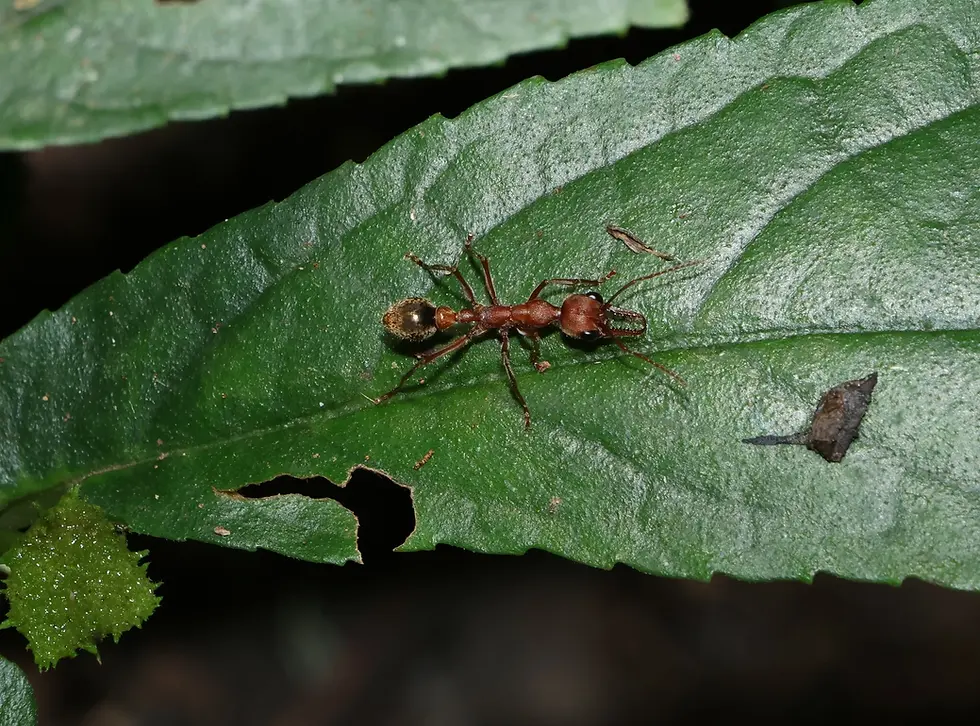
Opisthopsis rufithorax belongs to the strobe ants, a group of Australian ants named after the strange way they move. Researchers have only recently started to understand how these ants run, see and find their way home. Here are 10 facts about Opisthopsis rufithorax.
1. They are called strobe ants
Outside the nest, strobe ants move in quick, jerky bursts: run, stop, run, stop. It looks as if they are walking under a strobe light, and that is where the name comes from.
2. They do not jump
In 2018, researchers filmed strobe ants in slow motion with an ordinary phone camera and let them walk over smoked glass to record their footprints. They found that the ants do not jump. They walk with a normal insect gait, but so fast that all six legs can briefly leave the ground at the same time.
3. They stand still more than they run
The same study found that strobe ants spend about twice as much time standing still as moving. During every stop, they tap the ground with the tips of their antennae.
4. Nobody knows exactly why
The most likely explanation is that the ants run so fast that their brains need a moment to keep up with everything they see. Some very fast-running beetles do something similar. It has not been proven yet, so the strobe walk is still a bit of a mystery.
5. Their eyes sit at the back of the head

Compared with other ants in their subfamily, strobe ants have large eyes that sit towards the back of the head. That gives them a very wide view, even partly behind them.
6. They see fast movement very well
A study from 2025 compared the vision of two strobe ant species. Opisthopsis rufithorax turned out to have very fast vision: it can follow quick changes in what it sees better than its relative. That helps them spot moving prey and enemies.
7. They find their way with landmarks
Many ants use the sun as a compass. Opisthopsis rufithorax does not seem to. Instead, it relies strongly on landmarks around it, such as trees and other features of the landscape.
8. They take a shortcut home by falling
Workers forage high up in the trees, but they do not always climb down again. On the way home, they often simply drop from the canopy, and they usually drop on the side of the tree that faces the nest. After landing, they quickly orient themselves and walk home. The researchers think this saves time and reduces the risk of being caught by predators.
9. They are shy

Strobe ants are timid. When you come close, they quickly dart to the other side of a tree trunk or drop to the ground. They nest in the ground, but forage alone during the day on the ground and on tree trunks.
10. They are relatives of carpenter ants
The genus Opisthopsis has around twenty species and belongs to the same tribe as carpenter ants, Camponotus. Opisthopsis rufithorax is found across large parts of Australia and in New Guinea.
Keeping Opisthopsis rufithorax
Want to watch the strobe walk at home? Read our Opisthopsis rufithorax care guide or have a look at our Opisthopsis rufithorax colonies.
Sources
Waters, J. and McGlynn, T., 2018. How strobe ants do the strobe run. Myrmecological News. Summary on Small Pond Science.
Ramon Cabrera, G. M., 2025. Foraging ecology, navigation and the visual systems of the strobe ants, Opisthopsis. PhD thesis, Macquarie University.
AntWiki. Opisthopsis rufithorax.
Photos: © Nigel Main.

Comments