


Kenya Ant Smuggling: Why Messor cephalotes Ended Up in Court
Updated: 1 day ago
Messor cephalotes, the giant African harvester ant, is not the kind of animal you expect in a courtroom. Yet in 2025 and 2026, Kenyan courts sentenced several people for trying to smuggle thousands of these ants out of the country. Here is what happened, why these ants are so wanted, and what it means for ant keepers.
The 2025 case: thousands of queens in test tubes

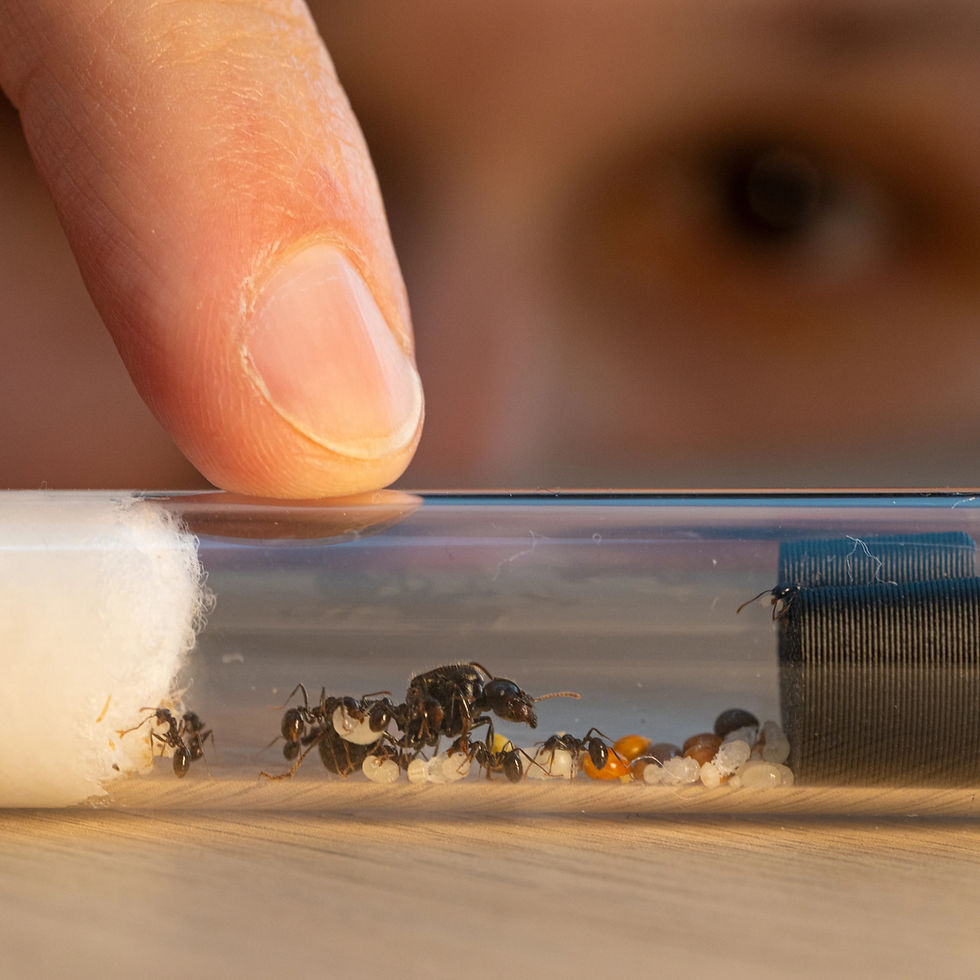
In April 2025, four men were arrested in Kenya with around 5,400 queen ants, mostly Messor cephalotes. Two of them were 19-year-old Belgians with about 5,000 queens; the other two were a Vietnamese man and a Kenyan man. The ants were packed in modified test tubes and syringes with cotton wool, which can keep queens alive for months. According to reports, they were meant for collectors in Europe and Asia.
In May 2025 the court sentenced all four to a year in prison or a fine of about $7,700. The magistrate called the case serious, saying the court would protect "all creatures great and small", but still gave less than the minimum sentence, because she did not see it as comparable to elephant poaching.
The 2026 case: a new arrest at Nairobi airport
In March 2026, a Chinese national was arrested at Nairobi airport with more than 2,200 live ants in his luggage, including about 1,950 Messor cephalotes queens. They were hidden in test tubes and rolls of tissue paper and were on their way to China. In April 2026 he was sentenced to a year in jail and a fine of one million Kenyan shillings, about $7,700. The judge pointed to the rising number of cases and asked for a deterrent sentence. A Kenyan man accused of selling ants to some of the people convicted in 2025 was still on trial at the time.
Why are these ants so wanted?
Messor cephalotes is the largest harvester ant in the world, with queens of more than 2 cm and huge majors. That makes it a dream species for many ant keepers in Europe, Asia and the United States. It is also an expensive species in shops, because only small numbers reach the market.
As far as we can tell, the people caught in 2025 were ant keepers themselves who wanted to bring more queens onto the market, which would have made the species much cheaper for other keepers. The intention may have been understandable, but the way they went about it was illegal.
Does this harm nature?
Many reports said that taking these queens threatens the ants and the savanna in Kenya. As ant keepers, we see it differently. During its nuptial flights, Messor cephalotes releases large numbers of young queens. In nature, only a tiny fraction of those queens ever manage to found a colony; most are eaten by birds, lizards and other ants, or die before their first workers arrive. Collecting a few thousand queens does not threaten the species or its habitat.
That does not make smuggling okay. Kenya's rules are clear, and breaking them makes honest, legal trade harder and hurts the reputation of the whole hobby. We at Esthetic Ants do not condone these actions.
What this means for ant keepers
Ask where your ants come from: a good seller can tell you where a colony comes from and whether it was exported legally. If a seller cannot answer, walk away.
Be suspicious of very cheap rare species: a price that is far too low for a species that is hard to get is a warning sign.
Never take ants home from a trip without checking the rules: many countries protect their wildlife, including insects, and taking them without a permit can be a crime.
Consider local or easier species: there are many fascinating species that are widely and legally available. Our post on which ant species to choose for your first ant farm is a good place to start.
The reputation of the whole hobby depends on keepers who buy responsibly. Want to know more about this species? Read our Messor cephalotes facts and the Messor cephalotes care guide, see how it compares in Messor cephalotes vs Messor barbarus, or have a look at our Messor cephalotes colonies.
Sources
Down To Earth, 2025. Ant smuggling in Kenya: four sentenced to 12 months in prison or $7,700 fine.
CP24 / Associated Press, 2026. Kenya sentences Chinese ant smuggler to year in jail.
Big3Africa, 2026. Kenya busts ant-smuggling ring, exposing new threat to biodiversity.


Comments