


Crematogaster scutellaris: 10 Facts About the Mediterranean Acrobat Ant
Updated: 1 day ago
Crematogaster scutellaris is one of the most common ants around the Mediterranean, and one of the most striking. With its red head, shiny black body and heart-shaped gaster, it is easy to recognise. Researchers have discovered some surprising things about it too. Here are 10 facts about this Mediterranean acrobat ant.
1. It is an acrobat with a weapon

Crematogaster ants are called acrobat ants because they can fold their gaster up over their back, as if doing a balancing act. Thanks to the heart shape of the gaster, the genus is also nicknamed the Saint Valentine ant. The raised gaster is not just for show: workers smear a defensive liquid from its tip on attackers, and it works especially well against other ants.
2. Red head, black body

The shiny red head against a dark body and black gaster makes this the easiest Crematogaster in Europe to recognise. Workers are small, roughly 3.5 to 5 mm, and all about the same size.
3. It is everywhere around the Mediterranean
Crematogaster scutellaris lives from North Africa through southern Europe to the Balkans, in both wild and managed landscapes such as olive orchards. Where it lives, it is often one of the dominant ants, with a big influence on the other insects around it.
4. It lives in trees, and even in cork
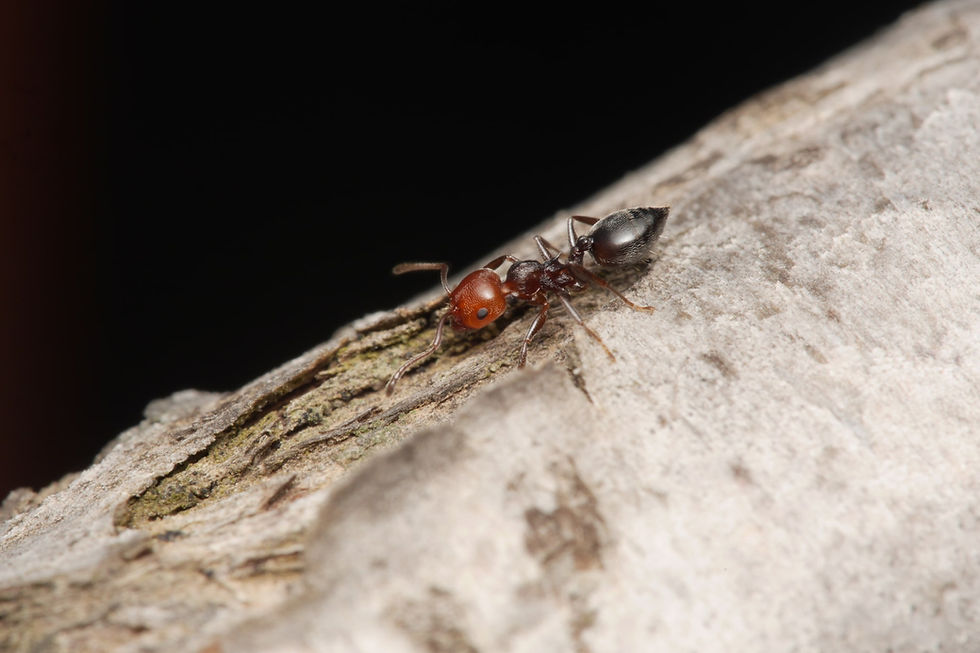
This is a true tree ant. Colonies nest in dead wood, under bark, in logs and sometimes in old walls. In the cork oak forests of southern Spain, colonies dig galleries and chambers right through the thick cork bark of the trees.
5. One queen, many nests
A colony has one queen, but it rarely lives in just one nest. Genetic research in an olive orchard near Florence found a main nest with the queen, connected to a network of satellite nests. Many colonies were spread over more than one tree.
6. It keeps live aphids in oak galls
Crematogaster scutellaris also nests in the hard, round galls that the marble gall wasp makes on oak trees. In 2021, Italian researchers discovered something new in those gall nests: live aphids. The ants actively searched for the aphids, collected them and stored them inside, unharmed. The researchers think the ants keep them safe over winter, so they have honeydew producers ready in spring.
7. It hunts fig wasps by smell
Fig trees are pollinated by tiny fig wasps, and Crematogaster scutellaris has learned to take advantage of that. Researchers found that the ants detect fig wasps by smell and hunt them as prey on the figs.
8. Mothers protect their young against disease
Researchers exposed founding queens to a small, harmless dose of a fungus that can kill ants. The offspring of those queens turned out to be better at surviving that fungus later. It was one of the first times this kind of protection from mother to offspring was shown in ants.
9. It has nasty neighbours
Not every meeting between two colonies ends in a fight, but colonies that live close together and smell more alike fight more often. Researchers call this the "nasty neighbour" effect: the closest neighbours are the biggest rivals.
10. It travelled to England in cork
Because it lives in cork bark, Crematogaster scutellaris has hitched a ride with shipments of cork. It was even found living around cork factories in England for a while, far outside its natural range.
Bonus: crickets live in its nest
The tiny ant cricket Myrmecophilus fuscus lives inside the nests of Crematogaster scutellaris, where it begs food from the workers and eats what it can find.
Keeping Crematogaster scutellaris
Want to keep this fast-growing acrobat yourself? Read our Crematogaster scutellaris care guide or have a look at our Crematogaster scutellaris colonies. Curious about another acrobat ant? Read our Crematogaster schmidti care guide.
Sources
AntWiki. Crematogaster scutellaris.
Giannetti, D. et al., 2021. First report on the acrobat ant Crematogaster scutellaris storing live aphids in its oak-gall nests. Insects.
Soria, F. J. et al., 1994. Estudio del comportamiento alimentario de Crematogaster scutellaris en tres alcornocales del SW español. Boletín de Sanidad Vegetal, Plagas.
Schatz, B., Anstett, M.-C., Out, W. and Hossaert-McKey, M., 2003. Olfactive detection of fig wasps as prey by the ant Crematogaster scutellaris. Naturwissenschaften.
Bordoni, A. et al., 2018. Trans-generational immunization in the acrobat ant Crematogaster scutellaris. Biology Letters.
Frizzi, F. et al., 2015. The rules of aggression: how genetic, chemical and spatial factors affect intercolony fights in the Mediterranean acrobat ant Crematogaster scutellaris. PLoS ONE.


Comments