


This Spider Catapults Green Tree Ants Into Its Web
Updated: 1 day ago
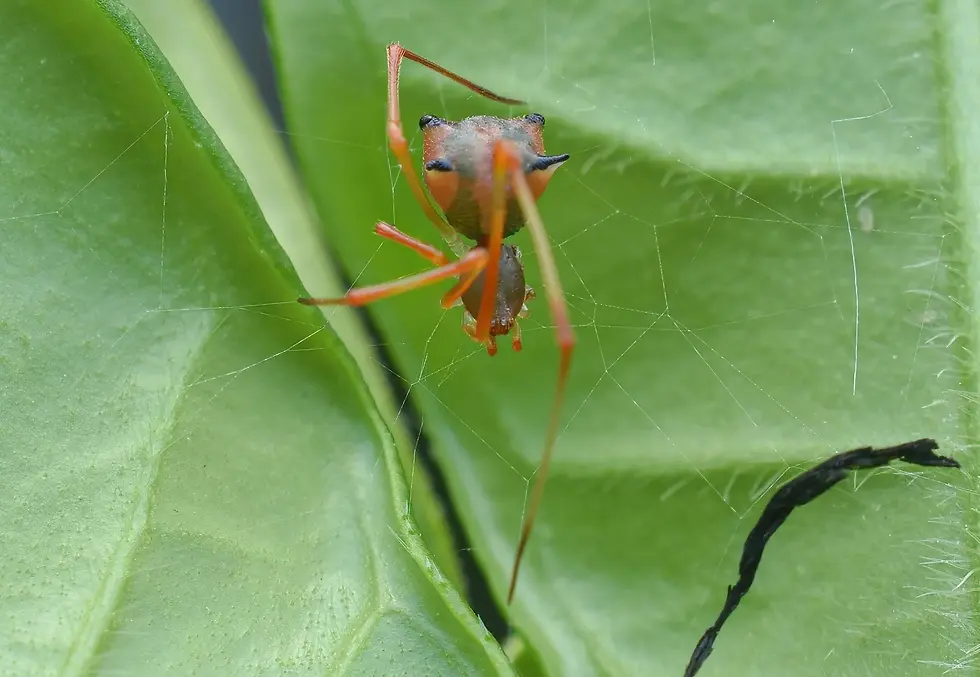
Most spiders stay far away from ants, and for good reason. Ants bite, spray acid and call in their nestmates when they are attacked. A newly discovered spider from the rainforests of northern Queensland, Australia, does the opposite: it hunts only green tree ants, Oecophylla smaragdina, and launches them into its web with a silk catapult. The study by researchers from Macquarie University was published in Current Biology.
A trap that the ant sets off

The spider belongs to the genus Propostira and has not been formally named yet. During the day it hides under a leaf above places where green tree ants forage. At night it lowers itself more than 50 cm, anchors a line and spends up to four hours building a cone of 15 to 60 tightly stretched silk threads close to the ground. When an aggressive ant bites into the cone, it pulls it loose from its anchor. The stored tension is released and the ant is flung more than 30 cm upwards into the main web, with an acceleration of more than 1,300 m/s². There the spider wraps it up.
"The mechanism is triggered by the prey rather than by the predator," says lead researcher Ajay Narendra. The researchers suspect the spider even adds a scent to the cone that provokes the ants to attack it, but that has not been proven yet. According to the team, the trap packs more power than any other known silk catapult in nature.
Why green tree ants?

Green tree ants are some of the most aggressive ants in the world. They work together in large numbers and do not hesitate to attack anything that comes near their nests. By catching them one at a time, away from their trails and nests, the spider avoids being overwhelmed by a crowd of angry ants.
What this means for ant keepers

Anyone who keeps Oecophylla knows how fast these ants react. Touch a leaf near their nest and workers rush out with open jaws, ready to bite and spray. That reflex is exactly what this spider uses against them. Want to know more about these weaver ants and how they weave leaves together with silk from their larvae? Read our Oecophylla smaragdina facts and the Oecophylla smaragdina care guide.
Sources
Narendra, A., Joshi, P., Liprandi, D., Anderson, G. J. and Wolff, J. O., 2026. Ballistic high-powered spider webs overcome dangerous prey defenses. Current Biology.
ScienceDaily, 2026. This newly discovered ballista spider catapults ants into a deadly trap.
Mongabay, 2026. This spider catapults ants.
Spider photos: © Prashantha Krishna M C (first photo) and © Tejas M (other photos), via iNaturalist. Ant photos: Esthetic Ants.


Comments