


How Strong Are Ants Really?
Updated: 1d
You have probably heard that an ant can lift many times its own body weight. Is that true? Yes, ants are incredibly strong for their size. But some of the numbers you read online need a bit of context. Leafcutter ants are a great example: they carry pieces of leaf much bigger than themselves. Living in the US? Read our Atta texana care guide.

How much can an ant carry?
Watch ants on a trail and you will see workers dragging seeds, insects and crumbs that are much heavier than themselves. Ants are often said to carry 10 to 50 times their own weight, depending on the species and the type of load. Heavy or awkward prey is often carried by several workers together, or cut into pieces first.
The 5,000 times claim
In 2014, engineers at Ohio State University studied the neck of the Allegheny mound ant (Formica exsectoides). They glued anaesthetised ants in a centrifuge and spun them until the neck joint stretched and broke. The neck only started to stretch at about 350 times body weight, and broke at 3,400 to 5,000 times body weight. That does not mean an ant lifts 5,000 times its weight, but it does show how strong the joint between head and body is. That joint carries every load an ant holds in its jaws.
Why are small animals so strong?
It is mostly a matter of size. When an animal gets smaller, its weight drops much faster than the strength of its muscles. A tiny ant therefore has a lot of muscle power compared with its own weight. That is also why a human-sized ant would not be a superhero: it would barely be able to carry itself.
Teamwork makes it stronger
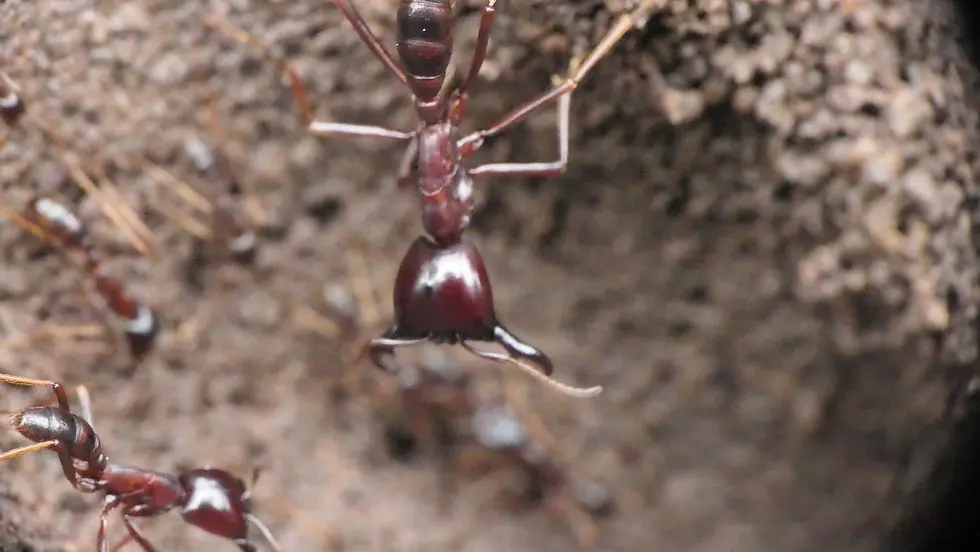
The real strength of ants is working together. Driver ants carry prey many times larger than one worker, and weaver ants form chains to pull leaves together for their nests. Read how driver ants hunt as one huge team. Want to see this teamwork yourself? Put some food in an outworld and watch your colony carry it home together.
Sources
Ohio State University, 2014. With their amazing necks, ants don't need high hopes to do heavy lifting. Journal of Biomechanics.
Photo: © Tom Kennedy


Comments