


How to Breed Fruit Flies as Live Ant Food: DIY Guide for Ant Keepers
Bijgewerkt op: 1 dag geleden
Fruit flies are one of the best foods for young ant colonies. They are small, soft and full of protein, so your ants can eat them whole and feed them to their larvae. You do not need to kill them or cut them into pieces first. Best of all, they are very easy to breed yourself, with things you probably already have at home. This guide shows you how.

Prefer to watch? In our video we show the whole process step by step. Below you can read everything again, with a few extra tips that did not fit in the video.
Why Flightless Fruit Flies?
For ants, you use flightless fruit flies. They can crawl and jump, but they cannot fly. That means they will not escape from your outworld or fly around your house. The benefits at a glance:
They are small enough for young queens and small workers.
They are soft, so there is almost nothing left over.
You can feed them alive. Your ants enjoy hunting them, and you do not need to kill them first.
They are full of protein, which is great for brood growth.
They are cheap. One culture quickly gives you hundreds of flies.
Two Species: Small and Large
Two species of flightless fruit flies are commonly used:
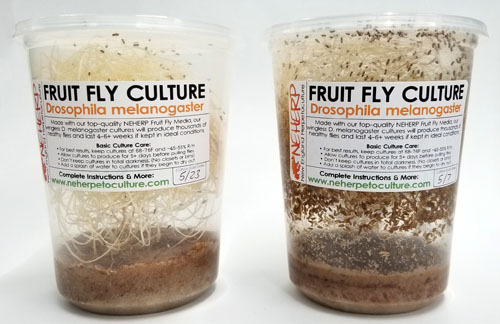
Drosophila melanogaster: the small species. It breeds fast and produces lots of flies. Ideal if you are just starting out, and for small ants or young queens.
Drosophila hydei: the large species, roughly twice the size. It grows more slowly and produces fewer flies, but makes a more substantial meal for larger ants.
Not sure? Start with the small species. It is the easiest and suits most ants, and many experienced keepers run both species side by side. For a full comparison, read Drosophila melanogaster vs Drosophila hydei: which fruit fly is best for your ants?
The Fruit Fly Life Cycle
It helps to know how a fruit fly grows up, so you know when to start a new culture. The adult flies lay eggs on the food in the container. Small white larvae hatch and eat their way through the food. After a while, they crawl upwards and pupate. New flies emerge from the pupae, and the cycle starts again.
At room temperature this goes fairly quickly for the small species; the large species takes longer. A culture produces flies for a few weeks and then runs out. So start a new culture regularly, and you will always have food in stock.
What You Need
A container: a plastic cup, a jar or an old tub. Make air holes in the lid and cover them with a piece of cloth or mesh so the flies cannot get out.
Instant mashed potato flakes. This is the base of the food.
A little sugar, honey or a piece of overripe banana.
Yeast, ordinary baker's yeast.
Water, and optionally a splash of beer and apple cider vinegar. Vinegar helps prevent mould.
Something to climb on: wood wool, a crumpled coffee filter or a few ice lolly sticks.
A group of flies to start with, from an existing culture.
Prefer to skip the shopping? Our Fruit Fly Culture Set has everything you need to get started.
How to Set Up a Culture, Step by Step
Clean the container and make holes in the lid if it does not have any yet. Cover them with a piece of cloth or mesh.
Put a few spoonfuls of potato flakes in the bottom, with a little sugar or a piece of banana.
Add some water, optionally with a splash of beer and vinegar. Stir until you have a thick paste. Not too wet, or the flies will drown. Not too dry, or the culture will not get going.
Sprinkle a small pinch of yeast over the food. It ferments and keeps mould away.
Place the climbing material on top, so the larvae can crawl up to pupate.
Add a good group of flies from an old culture and close the lid.
Write the date on the container and put it in a warm spot out of direct sunlight. Normal room temperature is fine.
Then it is a matter of waiting. After a while you will see small white larvae in the food. A bit later, brown pupae appear on the walls and the climbing material, and then the new flies emerge. Before you know it, the culture is full. Want to see it happen? Watch the video at the top of this post.
How to Feed Them to Your Ants
First tap the container gently on the table so the flies drop to the bottom. Open the lid a little, hold it over the outworld and tap out a few flies. Close the lid again straight away. Are they too fast? Put the culture in the fridge for a short while. The cold slows them down and makes them easier to transfer. Just do not forget to take it out again afterwards.
Keeping Your Culture Healthy and Odour-Free
Start a new culture regularly. A culture declines after a few weeks and starts to smell. Throw old cultures away and start again.
Keep the food moist, but not wet. If it is too dry, add a few drops of water. If it is too wet, add some extra potato flakes.
Avoid condensation on the walls of the container, as it encourages mould. A warm spot out of direct sunlight works best.
Use yeast and a splash of vinegar. This keeps mould and mites away and gives a mild smell instead of a rotten one.
Keep cultures apart from each other and away from bags of substrate or other organic material. Mites almost always come from contamination. If a culture gets mites, throw it away and start fresh.
Wash used containers well with hot water and soap, or use a new container.
Short on space, or only need a few flies? Many ant keepers breed them in test tubes: a little food in the bottom, a small stick to climb on and a cotton plug on top. When the culture is finished, you simply throw the tube away.

Also Great for Other Animals
Flightless fruit flies are not only good food for ants. Small frogs such as dart frogs, young praying mantises, jumping spiders and small lizards love them too. If you keep several animals, your own culture is extra handy.
Buying Fruit Flies
Don't want to start from scratch, or need flies for your first culture? Our Large Fruit Flies are ready-to-use cultures of flightless Drosophila hydei. You can feed your ants straight away and use the extra flies to start your own cultures. Want to do it all yourself? The Fruit Fly Culture Set contains the food, wood wool and a reusable container.
Happy breeding. Your ants will love it!


Opmerkingen